
temple magnolia 'Silver Cloud'
Also known as: Information to be completed
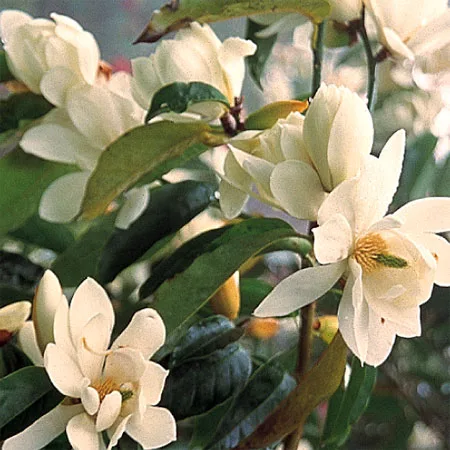
Small, semi-evergreen tree or large shrub with very long, oval, leathery dark green leaves, glaucous beneath. Large, bowl-shaped, multi-petalled, white flowers, to 20cm across, with about 30 tepals, formed in the autumn, are very fragrant and appear in late spring
Scientific classification
- Species
- temple magnolia 'Silver Cloud' (Magnolia doltsopa 'Silver Cloud')
- Genus
- Magnolia
- Family
- Magnoliaceae
- Information to be completed
- Toxicity
- Shrubs · Trees
- Plant type
- 8-12 metres
- Height
- 4-8 metres
- Spread
- Semi evergreen · Evergreen
- Foliage
- Bushy
- Habit
- Spring · Summer · Autumn · Winter
- Season of interest
- Full sun · Partial shade
- Sunlight
- Information to be completed
- Ideal temperature









temple magnolia 'Silver Cloud' pictures
Distribution of temple magnolia 'Silver Cloud'
Distribution map
Information to be completed
Information to be completed
Culture
Information to be completed
Toxicity
Information to be completed
Quick identification of temple magnolia 'Silver Cloud'
Information to be completed
temple magnolia 'Silver Cloud' care guide
- Keep soil moist and deep watered, especially young plants
- Watering
- Full sun · Partial shade
- Sunlight
- Information to be completed
- Ideal temperature

Watering
Keep soil moist and deep watered, especially young plants
Fertilizing
 Fertilizing
Balanced tree or shrub feed in early spring
Pruning
 Pruning
Prune lightly as needed to remove unwanted shoots and keep the shrub in shape. Prune in mid- to late spring.
Propagation
 Propagation
Propagate by semi-ripe cuttings from late summer to early autumn or layering in early spring
Growing
 Growing
Grow in moist but well-drained neutral to acid soil in full sun or partial shade with shelter from cold winds. \r\nHardy in coastal and relatively mild parts of the UK except in severe winters and a risk from sudden (early) frosts. See magnolia cultivation for further advice
People also ask
Information to be completed
Common pests and diseases
Diseases
May be susceptible to coral spot, phytophthora, grey moulds, honey fungus, a virus or fungal leaf spot
Pests
May be susceptible to scale insects, horse chestnut scale and capsid bug
Explore the plant health library →




