
heucherella 'Sweet Tea'
Also known as: Information to be completed
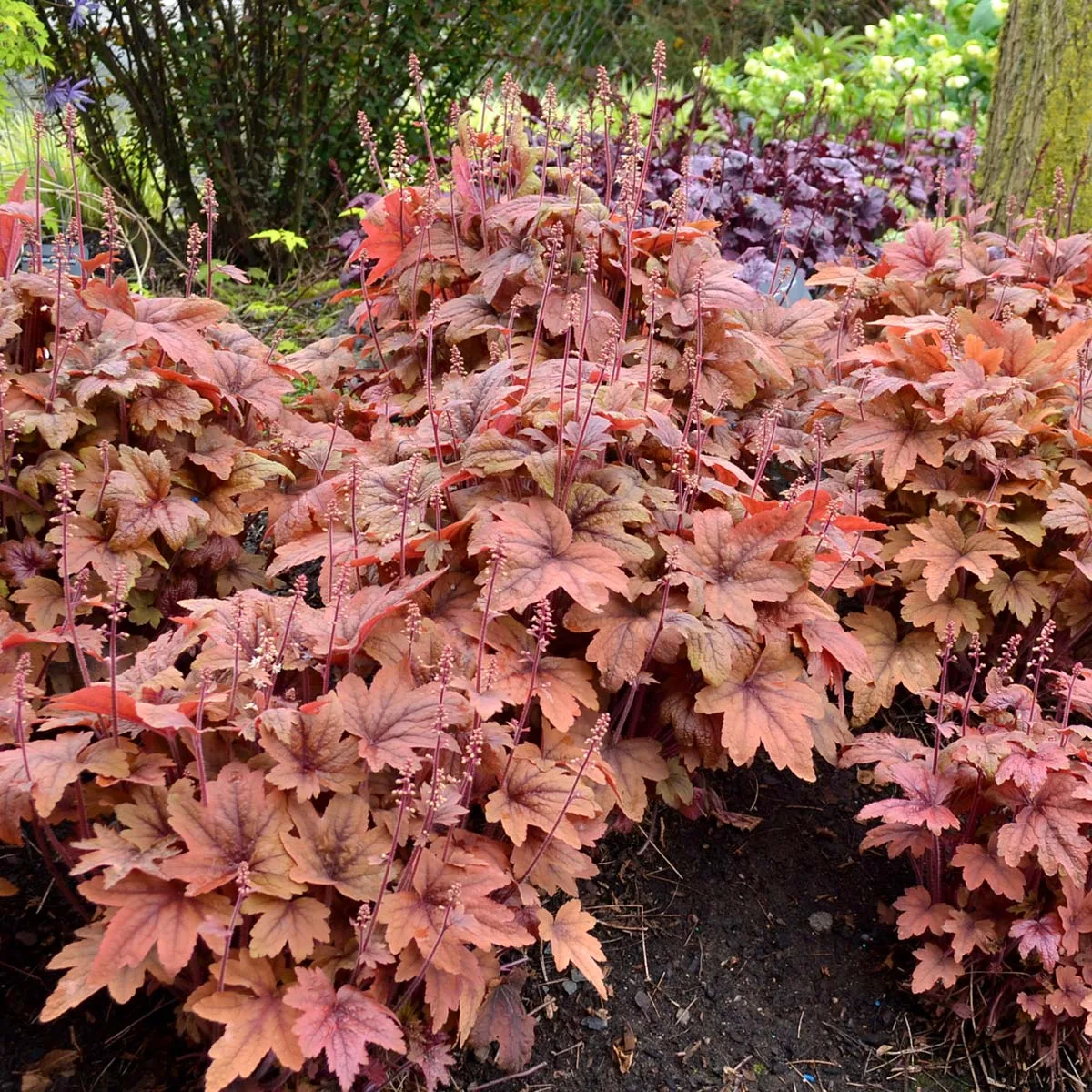
Sweet Tea' is a compact perennial forming a clump of maple-like, palmately-lobed burnt orange leaves, the main veins flushed with maroon. Colour deepens toward summer, pales somewhat in autumn and winter. Small white flowers are borne on stems to 50cm tall in spring and early summer
Scientific classification
- Species
- heucherella 'Sweet Tea' (×Heucherella 'Sweet Tea')
- Genus
- ×Heucherella
- Family
- Saxifragaceae
- Information to be completed
- Toxicity
- Herbaceous Perennial
- Plant type
- 0.1-0.5 metres
- Height
- 0.1-0.5 metres
- Spread
- Evergreen
- Foliage
- Clump forming
- Habit
- Autumn · Winter · Spring · Summer
- Season of interest
- Full sun · Partial shade
- Sunlight
- Information to be completed
- Ideal temperature









heucherella 'Sweet Tea' pictures
Distribution of heucherella 'Sweet Tea'
Distribution map
Information to be completed
Information to be completed
Culture
Information to be completed
Toxicity
Information to be completed
Quick identification of heucherella 'Sweet Tea'
Information to be completed
heucherella 'Sweet Tea' care guide
- Moderate regular watering, allowing brief slight drying between soakings
- Watering
- Full sun · Partial shade
- Sunlight
- Information to be completed
- Ideal temperature

Watering
Moderate regular watering, allowing brief slight drying between soakings
Fertilizing
 Fertilizing
Balanced perennial feed every four weeks from spring through summer
Pruning
 Pruning
Remove dead leaves and deadhead
Propagation
 Propagation
Can be propagated by division; this genus need to be divided regularly. Lift the plant once in spring growth, taking small vigorous sections from around the edge. Each section should have good roots and 2-3 shoots
Growing
 Growing
Grow in fertile, moist, but well-drained soil in sun or partial shade. If the soil is moist, a shadier position may be tolerated. To prevent the rhizomes rising to the surface, mulch annually and divide every few years
People also ask
Information to be completed
Common pests and diseases
Diseases
Generally disease-free
Pests
May be susceptible to vine weevil, especially when grown in containers
Explore the plant health library →




