
Delavay's fir
Also known as: Information to be completed
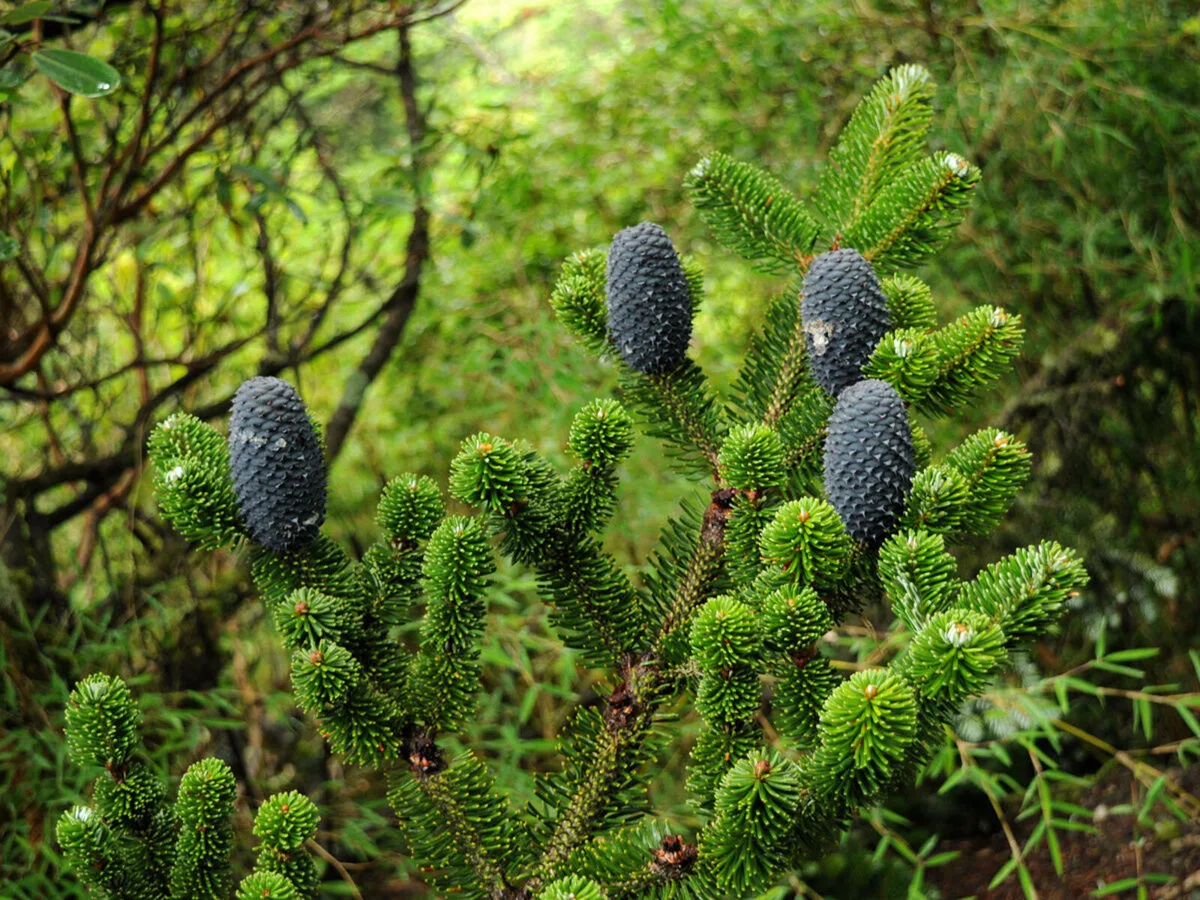
Large, upright-growing conical, evergreen coniferous tree, reaching up to 25m when mature. Young branches are reddish and glabrous, darkening in 2nd - 3rd year. New buds are resinous, small and globular. Leaves are densely set in several overlapping ranks, covering shoots in radial way. Needles are glossy, dark-green above, with two stomatal lines underneath. Up to 3cm long and 2.5mm wide, they are often curved or ''S''-shaped, flattened at the end. Ovoid seed cones, up to 8 cm long and 4 cm wide, are dark indigo-blue when young, maturing to black.
Scientific classification
- Species
- Delavay's fir (Abies delavayi)
- Genus
- Abies
- Family
- Pinaceae
- Information to be completed
- Toxicity
- Conifers · Trees
- Plant type
- Higher than 12 metres
- Height
- 4-8 metres
- Spread
- Evergreen
- Foliage
- Columnar upright
- Habit
- Spring · Summer · Autumn · Winter
- Season of interest
- Full sun
- Sunlight
- Information to be completed
- Ideal temperature









Delavay's fir pictures
Distribution of Delavay's fir
Distribution map
Information to be completed
Information to be completed
Culture
Information to be completed
Toxicity
Information to be completed
Quick identification of Delavay's fir
Information to be completed
Delavay's fir care guide
- Deep occasional watering, let soil drain freely
- Watering
- Full sun
- Sunlight
- Information to be completed
- Ideal temperature

Watering
Deep occasional watering, let soil drain freely
Fertilizing
 Fertilizing
Light slow release conifer feed in spring
Pruning
 Pruning
No pruning required
Propagation
 Propagation
Propagate by seed or by grafting.
Growing
 Growing
Grows best in deep, slightly acidic, moist but well-drained soils. New developing shoots and cones are sensitive to late frosts. It is best grown in areas with moist climate and abundant rainfall. See conifer cultivation
People also ask
Information to be completed
Common pests and diseases
Diseases
Generally disease-free, but mat be affected by honey fungus.
Pests
May be susceptible to adelgids and aphids
Explore the plant health library →




