
honeyberry
Also known as: Information to be completed
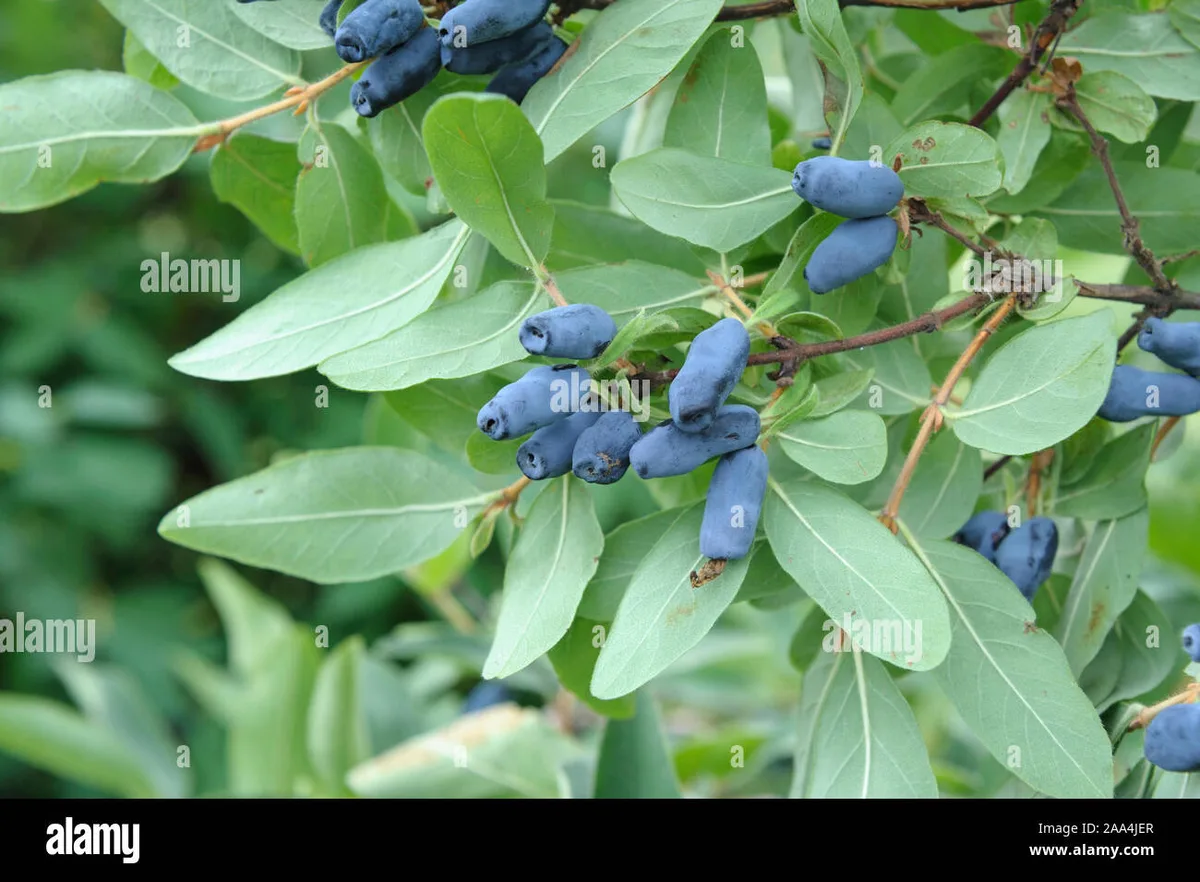
An upright, multi-stemmed deciduous edible fruit shrub with grey-green ovate-lance shaped leaves. Small white lightly fragrant flowers are produced in early spring followed by edible, oval cylindrical blue-black berry fruits which develop a white bloom when ripe for harvest in early summer.
Scientific classification
- Species
- honeyberry (Lonicera caerulea var. kamtschatica)
- Genus
- Lonicera
- Family
- Caprifoliaceae
- Information to be completed
- Toxicity
- Fruit Edible · Shrubs
- Plant type
- 1-1.5 metres
- Height
- 1-1.5 metres
- Spread
- Deciduous
- Foliage
- Bushy · Columnar upright
- Habit
- Spring · Summer
- Season of interest
- Full sun · Partial shade
- Sunlight
- Information to be completed
- Ideal temperature









honeyberry pictures
Distribution of honeyberry
Distribution map
- Native
- Introduced
- Cultivated
Source:WCVP v16 · Royal Botanic Gardens, Kew · CC BY 3.0 · Boundaries:WGSRPD / TDWG
Culture
Information to be completed
Toxicity
Information to be completed
Quick identification of honeyberry
Information to be completed
honeyberry care guide
- Moderate regular watering, deep soak only during prolonged hot spells
- Watering
- Full sun · Partial shade
- Sunlight
- Information to be completed
- Ideal temperature

Watering
Moderate regular watering, deep soak only during prolonged hot spells
Fertilizing
 Fertilizing
Balanced evergreen shrub feed applied once per early spring yearly
Pruning
 Pruning
Little pruning is needed. Remove diseased, damaged, crowded or crossing shoots and unwanted growth. Timing depends on the plant: generally late winter or early spring; plants prone to bleeding and deciduous magnolias need different timing, and deciduous azaleas and lilacs are pruned after flowering.
Propagation
 Propagation
Semi-ripe cutting can be taken during summer from none-fruiting stems. Hardwood cuttings can be taken in late-autumn winter.\r\nHoneyberry is easily propagated by seed; the pulp around the seed needs to be removed before they are sown in moist, warm conditions during the summer. There is no need for any cold stratification of the seed.
Growing
 Growing
Grow in full sun or partial shade in any moist, well-drained soil. Plant two shrubs for cross pollination and fruit set.
People also ask
Information to be completed
Common pests and diseases
Diseases
May be susceptible to powdery mildews, fungal leaf spot, silver leaf and honey fungus (rarely)
Pests
May be susceptible to honeysuckle aphids, Thrips and glasshouse whitefly
Explore the plant health library →




