
cabbage (Savoy) 'Noelle'
Also known as: cabbage (Savoy) 'Holly'
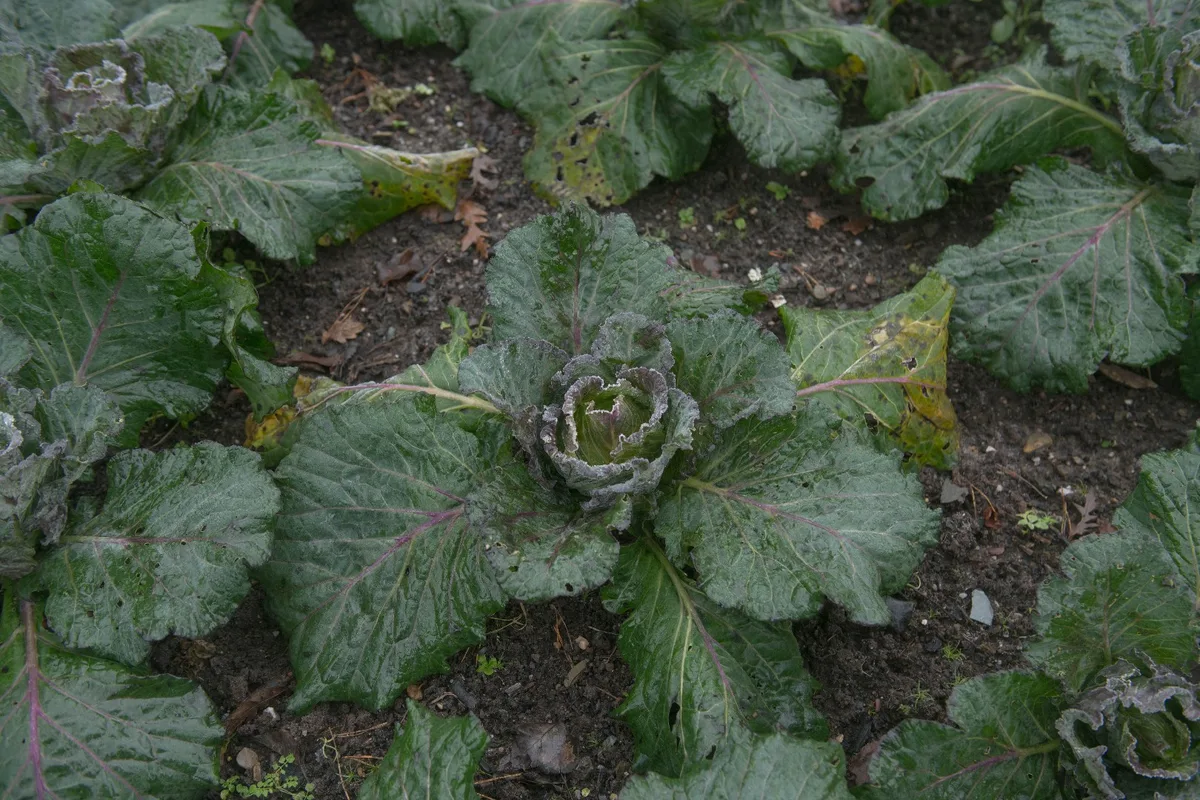
A British bred January King type hybrid which matures from October onwards and can be harvested through to March. It has an exceptional over wintering ability, showing outstanding colour, uniformity and and Winter hardiness. The striking blue-green leaves have purple veins and leaf margins which become more prominent in Winter, they have excellent flavour and texture
Scientific classification
- Species
- cabbage (Savoy) 'Noelle' (Brassica oleracea 'Noelle')
- Genus
- Brassica
- Family
- Brassicaceae
- Order
- Brassicales
- Class
- Magnoliopsida
- Phylum
- Tracheophyta
- Information to be completed
- Toxicity
- Annual Biennial
- Plant type
- 0.1-0.5 metres
- Height
- 0.5-1 metres
- Spread
- Deciduous
- Foliage
- Clump forming
- Habit
- Spring · Summer · Autumn · Winter
- Season of interest
- Full sun
- Sunlight
- Information to be completed
- Ideal temperature









cabbage (Savoy) 'Noelle' pictures
Distribution of cabbage (Savoy) 'Noelle'
Distribution map
- Native
- Introduced
- Cultivated
Source:WCVP v16 · Royal Botanic Gardens, Kew · CC BY 3.0 · Boundaries:WGSRPD / TDWG
cabbage (Savoy) 'Noelle' care guide
- Keep soil consistently moist for tender leafy growth
- Watering
- Full sun
- Sunlight

Watering
Keep soil consistently moist for tender leafy growth
Fertilizing
 Fertilizing
Nitrogen-rich vegetable feed during active growth
Pruning
 Pruning
No pruning required
Propagation
 Propagation
Propagate by seed. See sowing vegetable seeds
Growing
 Growing
Grow in fertile, moist but well drained soil in full sun. Sow indoors from March to June and transplant when seedlings have 5-6 true leaves, or sow direct from late March at a depth of 1cm and 23cm between rows. See vegetable cultivation
Common pests and diseases
Diseases
May be susceptible to black rot, clubroot, downy mildew, foot and root rot, leaf spot, white blister
Pests
May be susceptible to birds, cabbage caterpillars, cabbage gall weevil, cabbage root fly, cabbage whitefly, cutworms, flea beetle, mealy cabbage aphid, slugs and snails, swede midge
Explore the plant health library →




