
white bryony
Also known as: devil's cherry; devil's turnip; English mandrake; grapewort; Isle of Wight vine; murrain berries; red bryony; tetterberry; white wild vine; wild hop
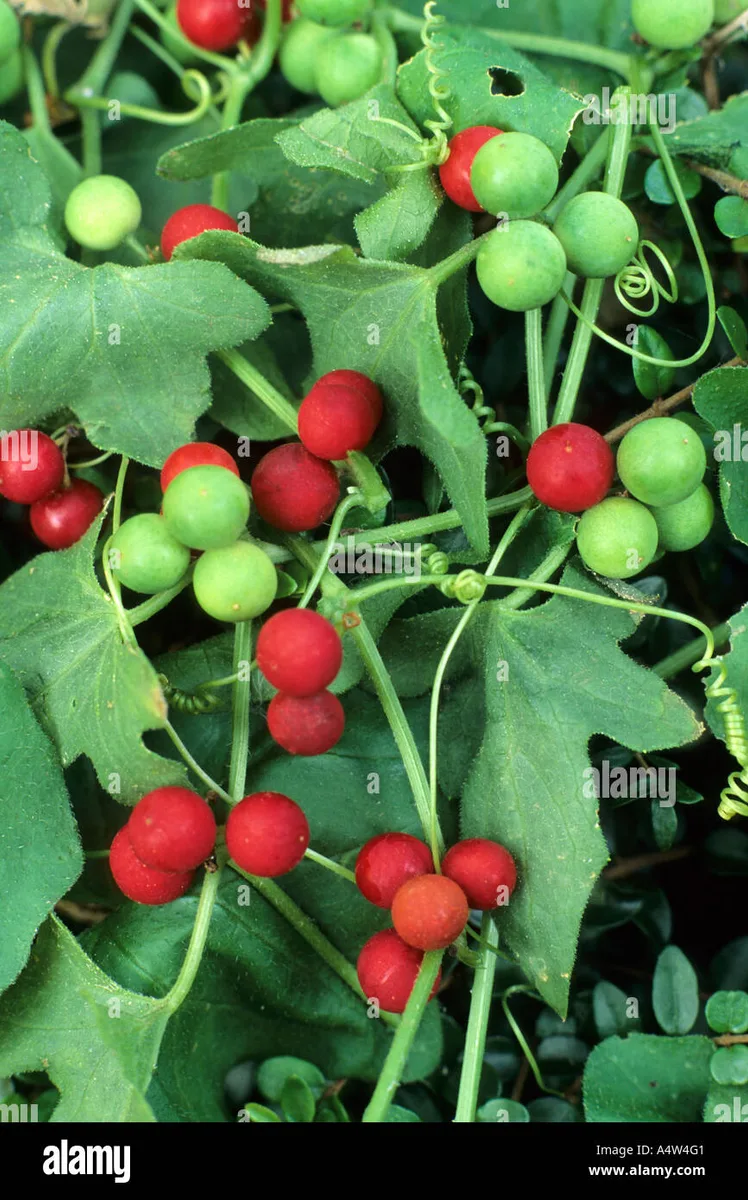
Britain's only native member of the cucumber family. It is an herbaceous, tendrilled climber with separate male and female plants. Leaves are entire and palmately 5 lobed. Greenish white flowers are borne in clusters in the leaf axils from May to August followed by hangingropes of berries that turn red in autumn
Scientific classification
- Species
- white bryony (Bryonia dioica)
- Genus
- Bryonia
- Family
- Cucurbitaceae
- Harmful if eaten. Wear glovesa and other protective equipment when handling
- Toxicity
- Climber Wall Shrub · Herbaceous Perennial
- Plant type
- 1.5-2.5 metres
- Height
- Information to be completed
- Spread
- Deciduous
- Foliage
- Climbing
- Habit
- Spring · Summer · Autumn
- Season of interest
- Full sun · Partial shade
- Sunlight
- Information to be completed
- Ideal temperature









white bryony pictures
Distribution of white bryony
Distribution map
Europe, Northern Africa, Southwestern Asia
Information to be completed
Culture
Information to be completed
Toxicity
Harmful if eaten. Wear glovesa and other protective equipment when handling
Quick identification of white bryony
Information to be completed
white bryony care guide
- Moderate regular watering, allowing brief slight drying between soakings
- Watering
- Full sun · Partial shade
- Sunlight
- Information to be completed
- Ideal temperature

Watering
Moderate regular watering, allowing brief slight drying between soakings
Fertilizing
 Fertilizing
Balanced perennial feed every four weeks from spring through summer
Pruning
 Pruning
No pruning required
Propagation
 Propagation
Propagate by seed
Growing
 Growing
Prefers well-drained, rich soils. Occurs naturally in hedgerows and woods
People also ask
Information to be completed
Common pests and diseases
Diseases
Generally disease-free
Pests
Generally pest-free
Explore the plant health library →




