
Cyclamen 'Tianis Fantasia Scarlet Red'
Also known as: Information to be completed
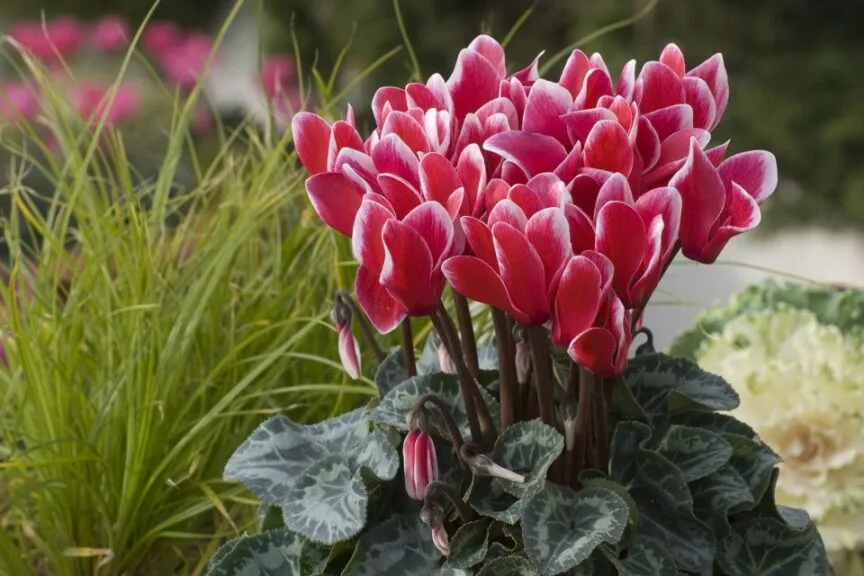
A half-hardy tuberous perennial, with heart-shaped dark green leaves with silver stripes and veins. Flowers have reflexed, bi-coloured petals, bright red at the base with a white margin at the tip, and are produced in late winter and early spring
Scientific classification
- Species
- Cyclamen 'Tianis Fantasia Scarlet Red' (Cyclamen 'Tianis Fantasia Scarlet Red')
- Genus
- Cyclamen
- Family
- Primulaceae
- Order
- Ericales
- Class
- Magnoliopsida
- Phylum
- Magnoliophyta
- Ornamental bulbs, not to be eaten. Wear gloves and other protective equipment when handling
- Toxicity
- Bulbs
- Plant type
- Up to 10 cm
- Height
- 0-0.1 metre
- Spread
- Deciduous
- Foliage
- Tufted
- Habit
- Spring · Winter
- Season of interest
- Partial shade
- Sunlight
- Information to be completed
- Ideal temperature









Cyclamen 'Tianis Fantasia Scarlet Red' pictures
Toxicity
Ornamental bulbs, not to be eaten. Wear gloves and other protective equipment when handling
Cyclamen 'Tianis Fantasia Scarlet Red' care guide
- Moderate regular watering, allowing brief slight drying between soakings
- Watering
- Partial shade
- Sunlight

Watering
Moderate regular watering, allowing brief slight drying between soakings
Fertilizing
 Fertilizing
Balanced perennial feed every four weeks from spring through summer
Pruning
 Pruning
No pruning required
Propagation
 Propagation
Propagate by seed, sown in darkness as soon as ripe. Can be beneficial to soak seed for 10 hours then rinse, prior to sowing
Growing
 Growing
Grow in a cool glasshouse or bulb-frame in a mix of equal parts loam, leaf mould, peat substitute and sharp sand. Plant with the tops of the tubers just at the surface. Provide bright, filtered light and moderate humidity. Water moderately when in growth but reduce humidity and water as the leaves fade. Keep completely dry when dormant. Apply a low-nitrogen liquid fertiliser every two months when in full leaf
Common pests and diseases
Diseases
May be susceptible to cyclamen grey mould and powdery mildews when grown under glass
Pests
May be susceptible to red spider mite, cyclamen mite and vine weevil when grown under glass
Explore the plant health library →




