
Dierama 'Pink Rocket'
Also known as: Information to be completed
A relatively compact evergreen perennial, to around 1m high in flower, with fine clumps of narrow, grass-like leaves. From mid to late summer, produces slender, wiry stems bearing a succession of bell-shaped pink flowers, often turned upward or outward rather than nodding
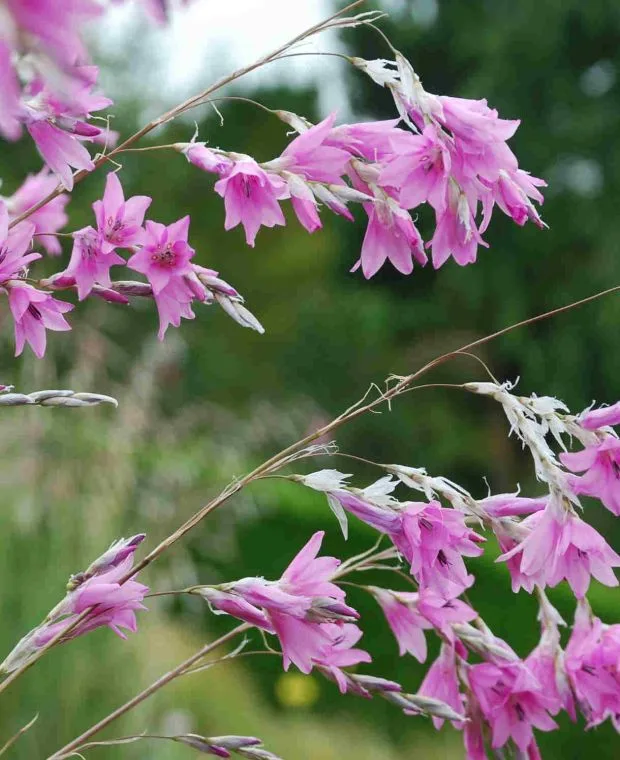
Scientific classification
- Species
- Dierama 'Pink Rocket' (Dierama 'Pink Rocket')
- Genus
- Dierama
- Family
- Iridaceae
- Information to be completed
- Toxicity
- Herbaceous Perennial · Bulbs
- Plant type
- 0.5-1 metres
- Height
- 0.1-0.5 metres
- Spread
- Semi evergreen
- Foliage
- Tufted · Clump forming
- Habit
- Spring · Summer · Autumn · Winter
- Season of interest
- Full sun
- Sunlight
- Information to be completed
- Ideal temperature









Dierama 'Pink Rocket' pictures
Distribution of Dierama 'Pink Rocket'
Distribution map
Information to be completed
Information to be completed
Culture
Information to be completed
Toxicity
Information to be completed
Quick identification of Dierama 'Pink Rocket'
Information to be completed
Dierama 'Pink Rocket' care guide
- Moderate regular watering, allowing brief slight drying between soakings
- Watering
- Full sun
- Sunlight
- Information to be completed
- Ideal temperature

Watering
Moderate regular watering, allowing brief slight drying between soakings
Fertilizing
 Fertilizing
Balanced perennial feed every four weeks from spring through summer
Pruning
 Pruning
Tidy any winter-damaged foliage by cutting to the base in spring
Propagation
 Propagation
Propagate by division of mature clumps, carefully separating corms in spring. Young plants and divisions can be slow to establish
Growing
 Growing
Grow in humus-rich, well drained soil in an open, sunny spot; these plants like moisture during the growing season but dislike winter wet. Add a compost mulch in spring. May benefit from winter protection in colder areas. See dierama cultivation for more detailed advice
People also ask
Information to be completed
Common pests and diseases
Diseases
Generally disease-free
Pests
Generally pest-free
Explore the plant health library →




