
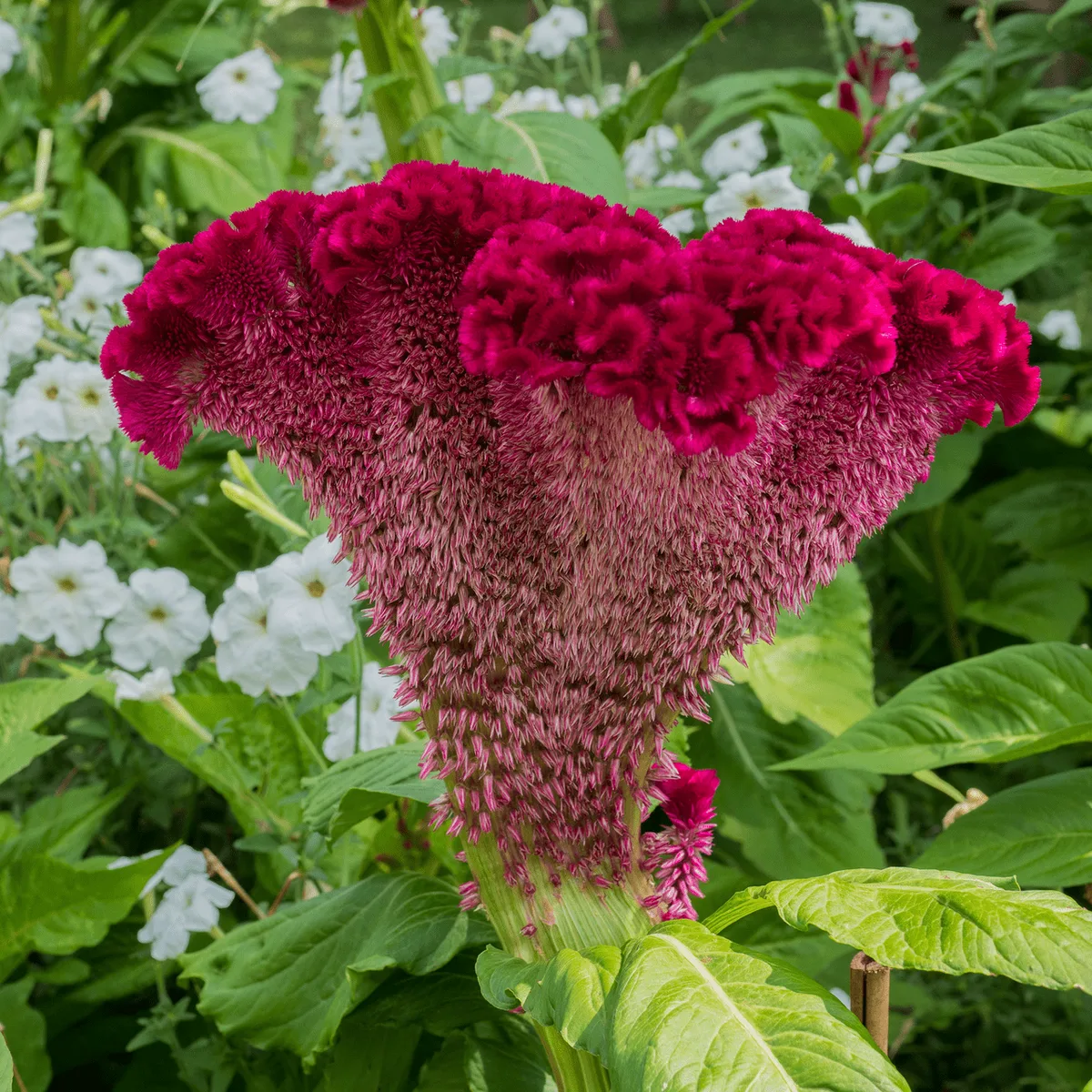
cockscomb 'Century Rose'
Also known as: Information to be completed
A bushy plant with plume-like inflorescences to 60cm on pale pink stems. Foliage is bright green andpink-flushed. Long lasting colour
Scientific classification
- Species
- cockscomb 'Century Rose' (Celosia argentea var. cristata 'Century Rose')
- Genus
- Celosia
- Family
- Amaranthaceae
- Order
- Caryophyllales
- Class
- Magnoliopsida
- Phylum
- Magnoliophyta
- Information to be completed
- Toxicity
- Annual Biennial
- Plant type
- 0.5-1 metres
- Height
- 0.1-0.5 metres
- Spread
- Deciduous
- Foliage
- Bushy
- Habit
- Summer · Autumn
- Season of interest
- Full sun
- Sunlight
- Information to be completed
- Ideal temperature









cockscomb 'Century Rose' pictures
Distribution of cockscomb 'Century Rose'
Distribution map
- Native
- Introduced
- Cultivated
Source:WCVP v16 · Royal Botanic Gardens, Kew · CC BY 3.0 · Boundaries:WGSRPD / TDWG
cockscomb 'Century Rose' care guide
- Moderate regular watering, drain standing water rapidly
- Watering
- Full sun
- Sunlight

Watering
Moderate regular watering, drain standing water rapidly
Fertilizing
 Fertilizing
Annual celosia feed biweekly warm growing summer months
Pruning
 Pruning
No pruning necessary
Propagation
 Propagation
Propagate by seed
Growing
 Growing
Annual that can be grown outside once frosts have passed. Grow in loam-based potting compost (JI No 1) in full light with good ventilation. Moist but well-drained fertile soil in full sun in a sheltered position. Apply a balanced liquid fertiliser every 2 weeks
Common pests and diseases
Diseases
Foot and root rot and fungal leaf spot diseases may occur
Pests
Glasshouse red spider mite, glasshouse whitefly and aphids may be a problem under glass
Explore the plant health library →




