
hollyhock 'Blacknight'
Also known as: Information to be completed
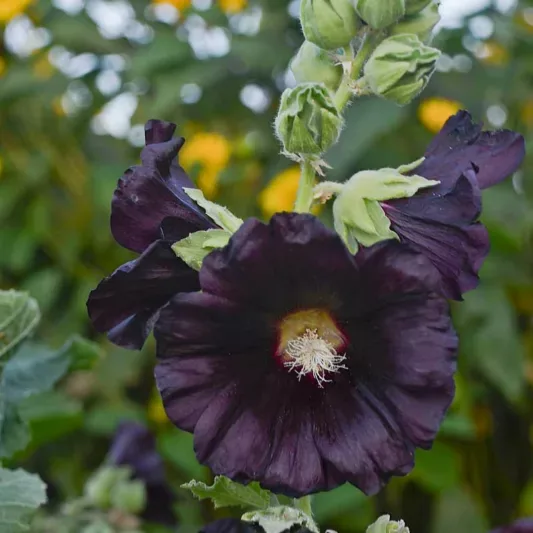
A short-lived perennial with lobed rounded leaves and long, erect pyramids of open funnel-shaped almost black single flowers with a contrasting pale yellow eye in summer.
Scientific classification
- Species
- hollyhock 'Blacknight' (Alcea rosea 'Blacknight')
- Genus
- Alcea
- Family
- Malvaceae
- Order
- Malvales
- Class
- Magnoliopsida
- Phylum
- Magnoliophyta
- Information to be completed
- Toxicity
- Annual Biennial
- Plant type
- 1.5-2.5 metres
- Height
- 0.1-0.5 metres
- Spread
- Deciduous
- Foliage
- Columnar upright
- Habit
- Spring · Summer · Autumn
- Season of interest
- Full sun
- Sunlight
- Information to be completed
- Ideal temperature









hollyhock 'Blacknight' pictures
Distribution of hollyhock 'Blacknight'
Distribution map
- Native
- Introduced
- Cultivated
Source:WCVP v16 · Royal Botanic Gardens, Kew · CC BY 3.0 · Boundaries:WGSRPD / TDWG
hollyhock 'Blacknight' care guide
- Water at base only, maintain slightly damp well-drained soil
- Watering
- Full sun
- Sunlight

Watering
Water at base only, maintain slightly damp well-drained soil
Fertilizing
 Fertilizing
Diluted bloom fertilizer every three weeks in active growth
Pruning
 Pruning
Cut back dead foliage after flowering or pull out and discard
Propagation
 Propagation
Propagate by seed
Growing
 Growing
Will grow well in slightly fertile well-drained soil in full sun. Staking might be necessary in exposed areas
Common pests and diseases
Diseases
May be susceptible to rust
Pests
May be susceptible to slugs and flea beetles
Explore the plant health library →




