
Geranium nodosum 'Clos de Coudray'
Also known as: Information to be completed
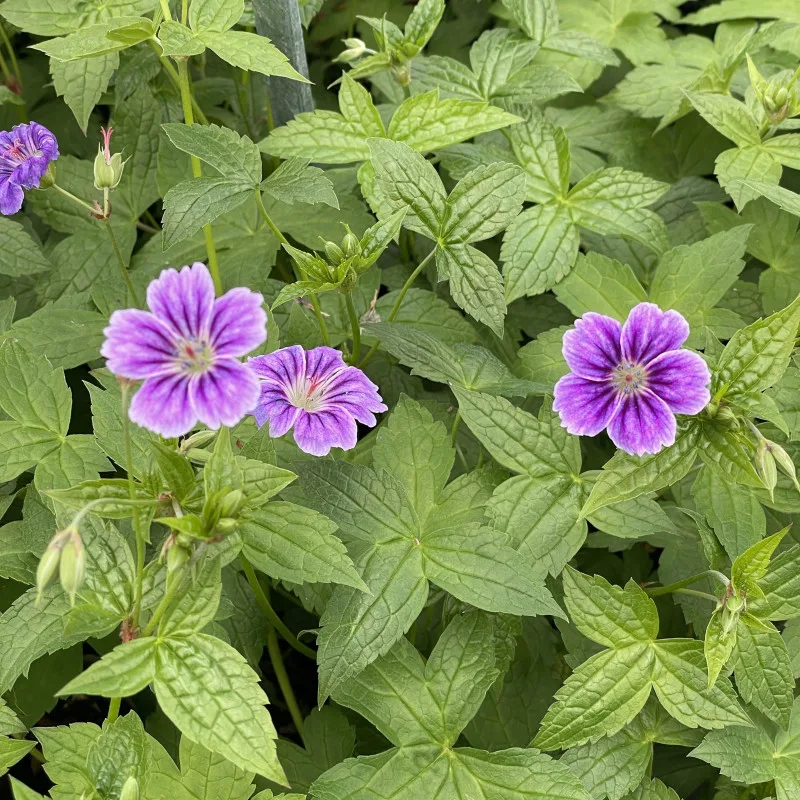
A reasonably compact, semi-evergreen, clump-forming herbaceous perennial, retaining its foliage in all except very cold winters. Lobed glossy green foliage is produced on stems to 45cm (18in) and across along with mid purple flowers fading to a paler edge on the petals and darker purple veins. Its tolerance of dry shade once established make it a useful subject for growing beneath taller growing shrubs
Scientific classification
- Species
- Geranium nodosum 'Clos de Coudray' (Geranium nodosum 'Clos de Coudray')
- Genus
- Geranium
- Family
- Geraniaceae
- Order
- Geraniales
- Class
- Magnoliopsida
- Phylum
- Tracheophyta
- Information to be completed
- Toxicity
- Herbaceous Perennial
- Plant type
- 0.1-0.5 metres
- Height
- 0.1-0.5 metres
- Spread
- Semi evergreen · Deciduous
- Foliage
- Clump forming
- Habit
- Spring · Summer · Autumn
- Season of interest
- Partial shade
- Sunlight
- Information to be completed
- Ideal temperature









Geranium nodosum 'Clos de Coudray' pictures
Distribution of Geranium nodosum 'Clos de Coudray'
Distribution map
- Native
- Introduced
- Cultivated
Source:WCVP v16 · Royal Botanic Gardens, Kew · CC BY 3.0 · Boundaries:WGSRPD / TDWG
Geranium nodosum 'Clos de Coudray' care guide
- Moderate regular watering, avoid prolonged drought and stagnant waterlogging
- Watering
- Partial shade
- Sunlight

Watering
Moderate regular watering, avoid prolonged drought and stagnant waterlogging
Fertilizing
 Fertilizing
Balanced perennial feed every four weeks spring through summer growth
Pruning
 Pruning
Cut old, winter-damaged foliage back to the ground in spring
Propagation
 Propagation
Propagate by division in spring or propagate by basal cuttings in early to mid spring and root with bottom heat. The plant can seed itself around once established but seedlings may not come true to the named cultivar.
Growing
 Growing
Grow in moderately fertile, well-drained soil in partial shade. The plant can tolerate dry shade once established.
Common pests and diseases
Diseases
May be susceptible to Powdery mildews, downy mildews and a virus
Pests
May be susceptible to vine weevil, geranium sawfly, slugs and snails
Explore the plant health library →




