
alum root 'Electric Lime'
Also known as: Information to be completed
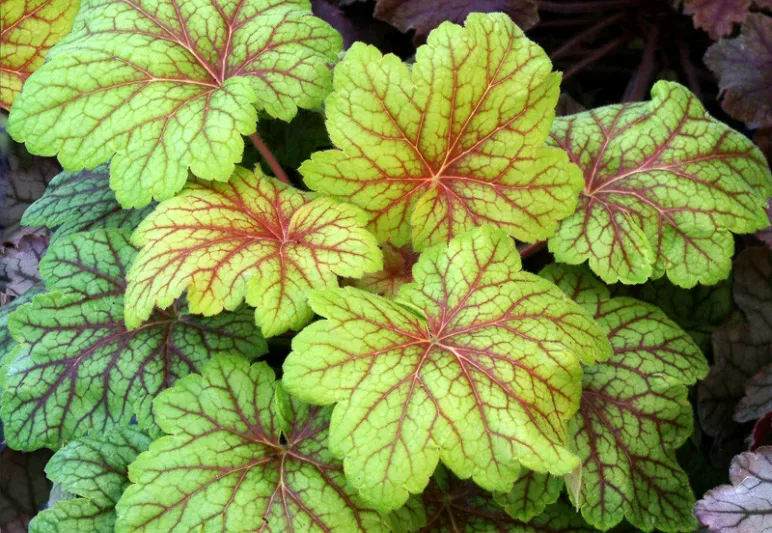
A clump-forming perennial to about 30cm high, forming a mound of lobed leaves that are bright yellow-green in spring and summer, with deep red veining that becomes more visible as the leaves mature. Loose sprays of small white flowers are held on slender stems above the foliage in summer
Scientific classification
- Species
- alum root 'Electric Lime' (Heuchera 'Electric Lime')
- Genus
- Heuchera
- Family
- Saxifragaceae
- Information to be completed
- Toxicity
- Herbaceous Perennial
- Plant type
- 0.1-0.5 metres
- Height
- 0.1-0.5 metres
- Spread
- Semi evergreen
- Foliage
- Clump forming
- Habit
- Spring · Summer · Autumn · Winter
- Season of interest
- Full shade · Partial shade
- Sunlight
- Information to be completed
- Ideal temperature









alum root 'Electric Lime' pictures
Distribution of alum root 'Electric Lime'
Distribution map
Information to be completed
Information to be completed
Culture
Information to be completed
Toxicity
Information to be completed
Quick identification of alum root 'Electric Lime'
Information to be completed
alum root 'Electric Lime' care guide
- Moderate regular watering, allowing brief slight drying between soakings
- Watering
- Full shade · Partial shade
- Sunlight
- Information to be completed
- Ideal temperature

Watering
Moderate regular watering, allowing brief slight drying between soakings
Fertilizing
 Fertilizing
Balanced perennial feed every four weeks from spring through summer
Pruning
 Pruning
Remove faded flower spikes
Propagation
 Propagation
Propagate by division in autumn
Growing
 Growing
Grow in a fertile, neutral soil in partial or full shade, and ensure good drainage, especially in heavy soils. The woody rootstock tends to lift out of the ground over time, so mulch annually to retain moisture. Divide and replant every 3-4 years to maintain vigour
People also ask
Information to be completed
Common pests and diseases
Diseases
May be susceptible to heuchera rust and leafy gall
Pests
May be susceptible to leaf and bud eelworm and vine weevil
Explore the plant health library →




