
white willow 'Flame'
Also known as: Information to be completed
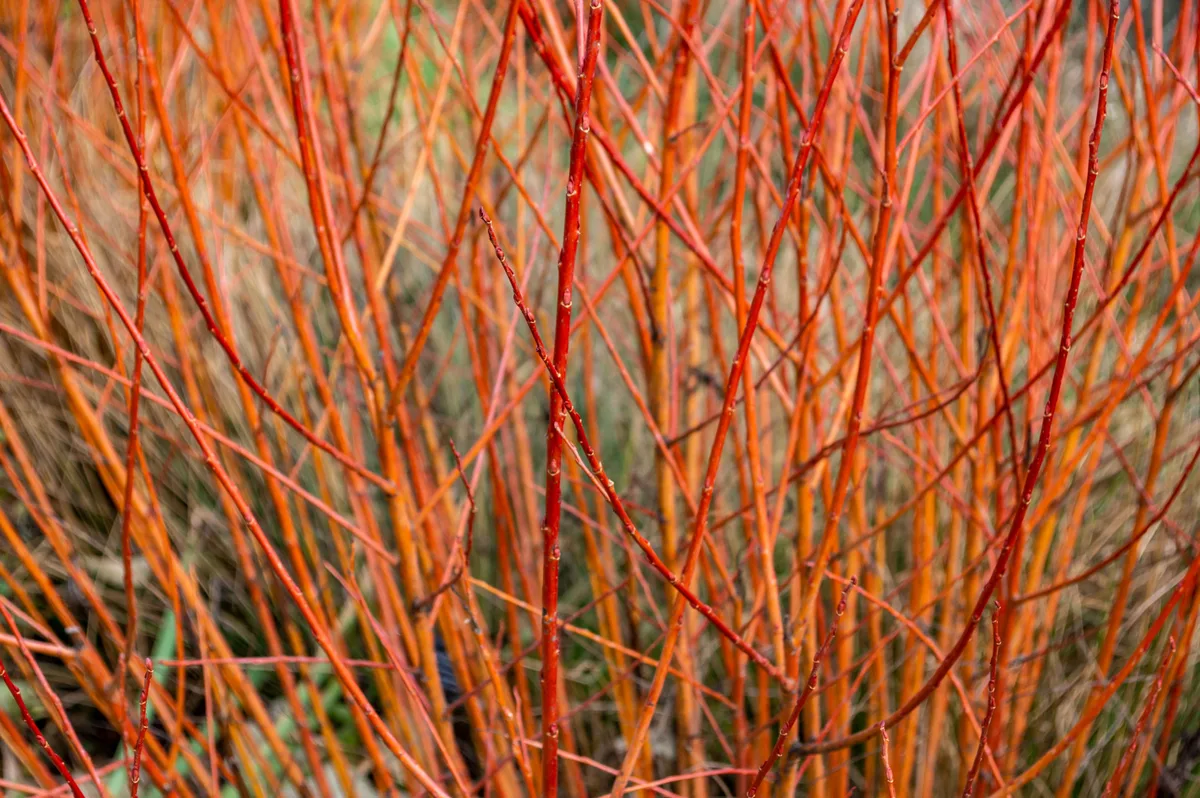
A dense, deciduous, oval-shaped tree to around 6m in height, which is usually cut back as a shrub. It has long-lasting yellow foliage and bright vibrant red-orange stems which curl inwards and provide fiery colour throughout the winter
Scientific classification
- Species
- white willow 'Flame' (Salix alba 'Flame')
- Genus
- Salix
- Family
- Salicaceae
- Order
- Malpighiales
- Class
- Magnoliopsida
- Phylum
- Tracheophyta
- Information to be completed
- Toxicity
- Trees · Shrubs
- Plant type
- 4-8 metres
- Height
- 2.5-4 metres
- Spread
- Deciduous
- Foliage
- Bushy
- Habit
- Spring · Summer · Autumn · Winter
- Season of interest
- Full sun
- Sunlight
- Information to be completed
- Ideal temperature









white willow 'Flame' pictures
white willow 'Flame' care guide
- Water generously in growing season, tolerates brief flooded soil
- Watering
- Full sun
- Sunlight

Watering
Water generously in growing season, tolerates brief flooded soil
Fertilizing
 Fertilizing
Slow release tree fertilizer applied once at early spring each year
Pruning
 Pruning
Little pruning is needed. Remove diseased, damaged, crowded or crossing shoots and unwanted growth. Timing depends on the plant: generally late winter or early spring; plants prone to bleeding and deciduous magnolias need different timing, and deciduous azaleas and lilacs are pruned after flowering.
Propagation
 Propagation
Propagate by softwood cuttings in early summer or hardwood cuttings in winter; may also be propagated by large sets, up to 3.5m long and 2-3cm thick
Growing
 Growing
Grow in full sun in moist or wet soil; avoid planting near buildings because its roots take up a lot of water from a wide area
Common pests and diseases
Diseases
May be susceptible to willow anthracnose, watermark disease, willow heart rot, rust diseases, crown gall, honey fungus, root rot, silver leaf, and tar spot
Pests
May be susceptible to aphids, caterpillars, gall mites, flea beetles, sawfly larvae, and willow scale
Explore the plant health library →




