
blue potato bush 'Variegata'
Also known as: Information to be completed
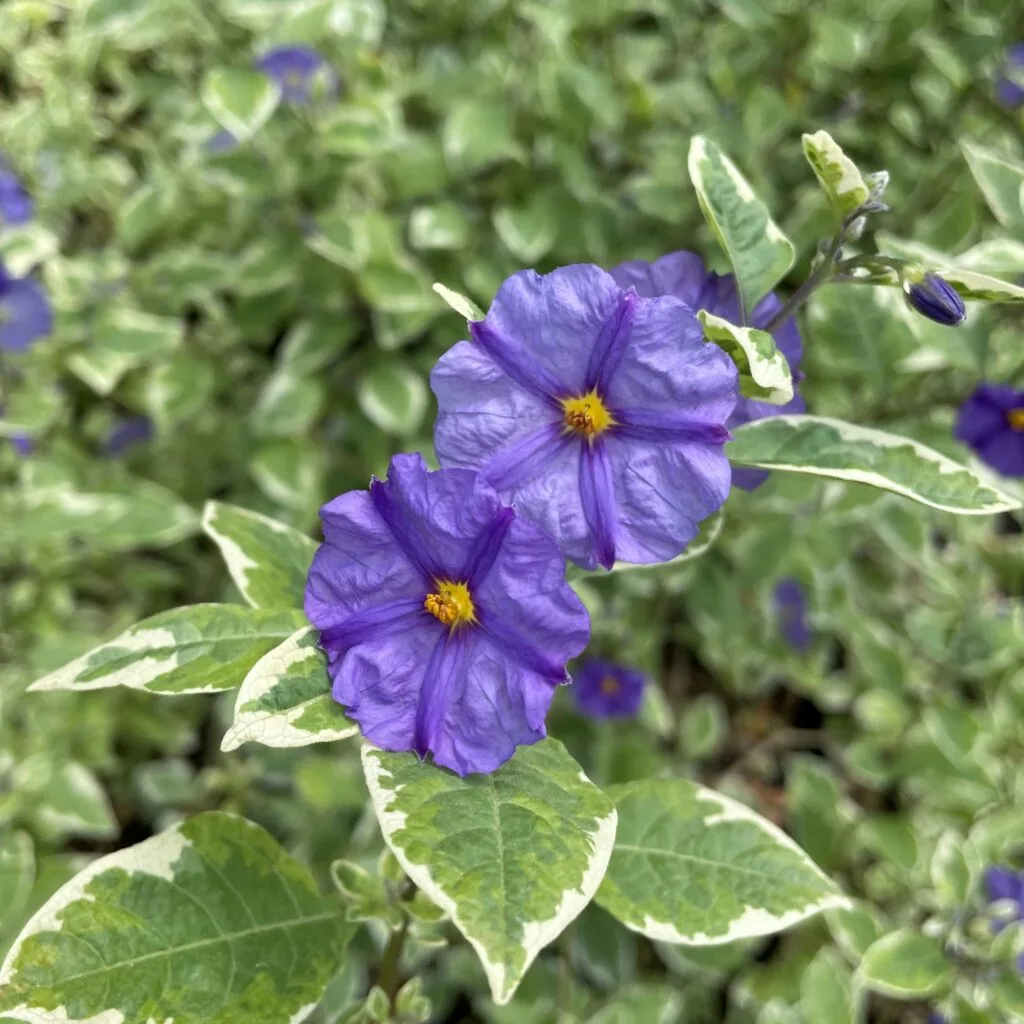
A lax, evergreen shrub with green and white variegated foliage and clusters of lightly fragrant saucer-shaped purple flowers with yellow centres which appear from summer through until autumn
Scientific classification
- Species
- blue potato bush 'Variegata' (Lycianthes rantonnetii 'Variegata')
- Genus
- Lycianthes
- Family
- Solanaceae
- Order
- Solanales
- Class
- Magnoliopsida
- Phylum
- Magnoliophyta
- All parts can cause severe discomfort if eaten. Wear gloves and other protective equipment when handling
- Toxicity
- Climber Wall Shrub · Conservatory Greenhouse
- Plant type
- 1.5-2.5 metres
- Height
- 1.5-2.5 metres
- Spread
- Evergreen
- Foliage
- Bushy
- Habit
- Spring · Summer · Autumn · Winter
- Season of interest
- Full sun
- Sunlight
- Information to be completed
- Ideal temperature









blue potato bush 'Variegata' pictures
Distribution of blue potato bush 'Variegata'
Distribution map
- Native
- Introduced
- Cultivated
Source:WCVP v16 · Royal Botanic Gardens, Kew · CC BY 3.0 · Boundaries:WGSRPD / TDWG
Toxicity
All parts can cause severe discomfort if eaten. Wear gloves and other protective equipment when handling
blue potato bush 'Variegata' care guide
- Moderate watering, partial soil drying permitted between waterings
- Watering
- Full sun
- Sunlight

Watering
Moderate watering, partial soil drying permitted between waterings
Fertilizing
 Fertilizing
Balanced flowering shrub feed once every thirty days in growth
Pruning
 Pruning
Prune lightly as needed to remove unwanted shoots and keep the shrub in shape. Prune in mid- to late spring.
Propagation
 Propagation
Propagate by seed, or semi-ripe cuttings taken in summer or early autumn and rooted with gentle bottom heat
Growing
 Growing
May survive as a wall-shrub in very mild areas, or grow as a standard in a pot and take under cover for winter. Otherwise grow in a cool greenhouse or conservatory with shade from the brightest sun and moderate humidity. Plants will require support
Common pests and diseases
Diseases
May be susceptible to grey moulds under glass
Pests
May be susceptible to aphids and glasshouse red spider mites whilst under glass
Explore the plant health library →




