
spleenwort 'Osaka'
Also known as: Information to be completed
A compact evergreen Bird's Nest fern cultivar, forms an upright rosette of long shiny, rich green arching leaves which have finely rippled undulating edges giving a highly decorative appearance.
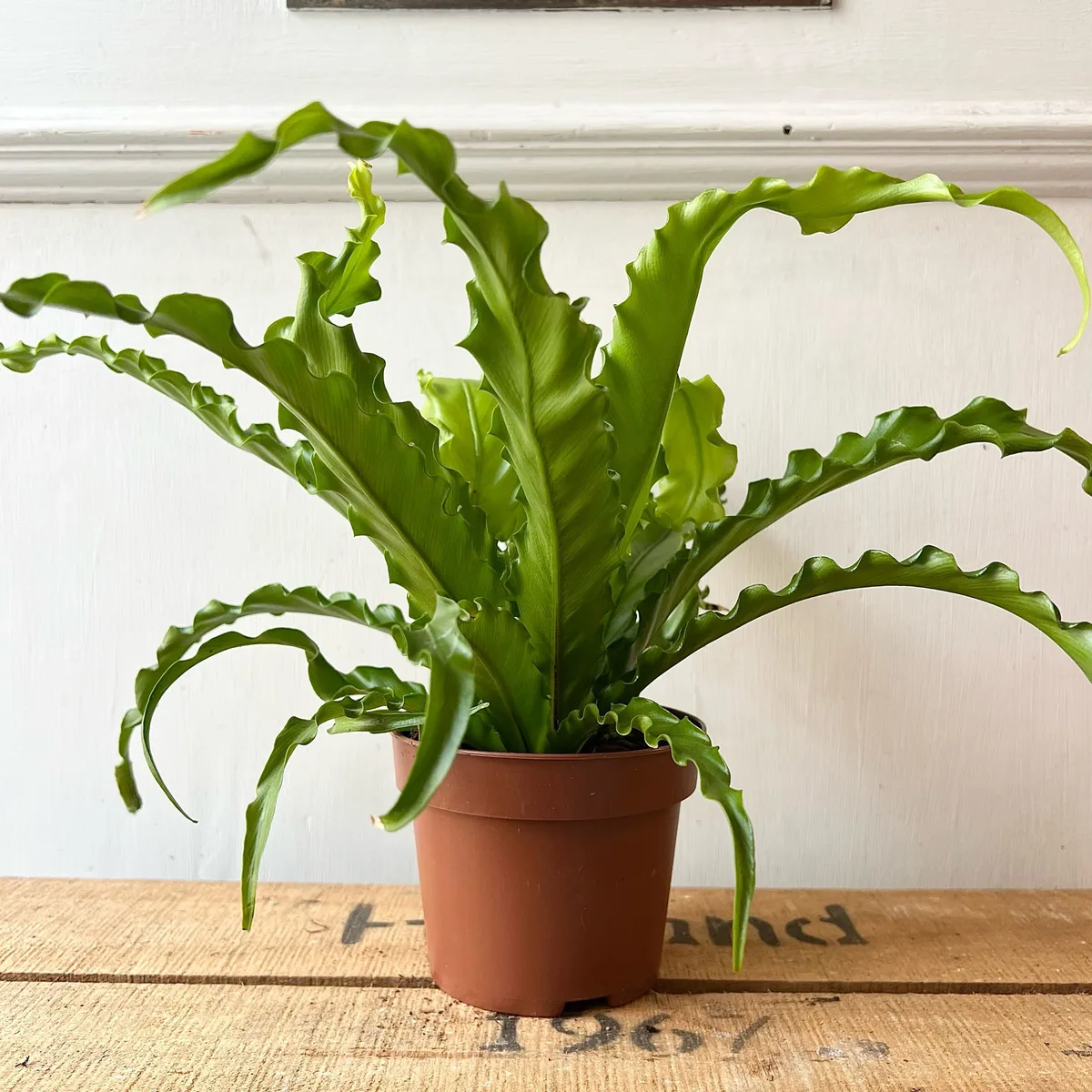
Scientific classification
- Species
- spleenwort 'Osaka' (Asplenium antiquum 'Osaka')
- Genus
- Asplenium
- Family
- Aspleniaceae
- Order
- Polypodiales
- Class
- Polypodiopsida
- Phylum
- Polypodiophyta
- Information to be completed
- Toxicity
- Ferns · Houseplants
- Plant type
- 0.5-1 metres
- Height
- 0.5-1 metres
- Spread
- Evergreen
- Foliage
- Tufted
- Habit
- Spring · Summer · Autumn · Winter
- Season of interest
- Partial shade
- Sunlight
- Information to be completed
- Ideal temperature









spleenwort 'Osaka' pictures
Distribution of spleenwort 'Osaka'
Distribution map
- Native
- Introduced
- Cultivated
Source:WCVP v16 · Royal Botanic Gardens, Kew · CC BY 3.0 · Boundaries:WGSRPD / TDWG
spleenwort 'Osaka' care guide
- Keep soil evenly moist with higher air humidity
- Watering
- Partial shade
- Sunlight

Watering
Keep soil evenly moist with higher air humidity
Fertilizing
 Fertilizing
Weak balanced feed during active frond growth
Pruning
 Pruning
Dead and damaged fronds may be removed as necessary
Propagation
 Propagation
Propagate by spores or tissue culture
Growing
 Growing
Prefers indirect sunlight, occasional exposure to natural indirect light or artificial light, or shade. Placed outdoors leaves scorch easily. In nature, epipytic on trees or lithophytic on rocks with limited access to soil. Grow in well-drained equal part loam, leafmould/ peat substitute and perlite. Prefers high humidity. Mist regularly and provide regular watering at the outer soil margins rather than directly onto the plant to keep moist but not wet, and avoid rot. Keep away from draughts at cool average temperatures between 16-21°C.
Common pests and diseases
Diseases
May be susceptible to rust
Pests
May be susceptible to scale, leaf and bud eelworms
Explore the plant health library →




