
Malva sylvestris var. mauritiana 'Mystic Merlin'
Also known as: Information to be completed
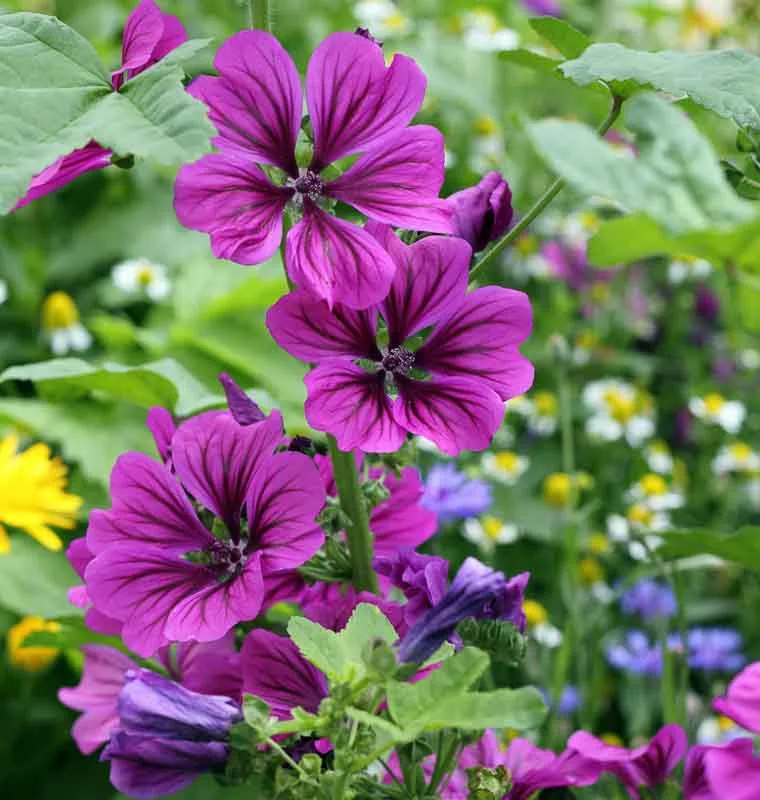
A woody-based, short-lived perennial often grown as an annual or biennial, with lobed and toothed green leaves. Can reach up to 1.8m high in flower, producing clusters of flowers in shades of mauve, purple and blue, with darker veins. Flowers from early to late summer
Scientific classification
- Species
- Malva sylvestris var. mauritiana 'Mystic Merlin' (Malva sylvestris var. mauritiana 'Mystic Merlin')
- Genus
- Malva
- Family
- Malvaceae
- Order
- Malvales
- Class
- Magnoliopsida
- Phylum
- Magnoliophyta
- Information to be completed
- Toxicity
- Herbaceous Perennial · Annual Biennial
- Plant type
- 1.5-2.5 metres
- Height
- 0.1-0.5 metres
- Spread
- Semi evergreen
- Foliage
- Bushy · Columnar upright
- Habit
- Spring · Summer · Autumn · Winter
- Season of interest
- Full sun
- Sunlight
- Information to be completed
- Ideal temperature









Malva sylvestris var. mauritiana 'Mystic Merlin' pictures
Distribution of Malva sylvestris var. mauritiana 'Mystic Merlin'
Distribution map
- Native
- Introduced
- Cultivated
Source:WCVP v16 · Royal Botanic Gardens, Kew · CC BY 3.0 · Boundaries:WGSRPD / TDWG
Malva sylvestris var. mauritiana 'Mystic Merlin' care guide
- Moderate regular watering, more in hot flowering weather
- Watering
- Full sun
- Sunlight

Watering
Moderate regular watering, more in hot flowering weather
Fertilizing
 Fertilizing
Light balanced feed in spring and midsummer
Pruning
 Pruning
No pruning required
Propagation
 Propagation
Propagate by seed or by softwood cuttings. Plants can be short-lived so annual propagation is recommended; early sowings may flower in the first year. May self-seed in place, though seedlings may vary
Growing
 Growing
Thrives in light, moderately fertile, well drained soil in full sun; may need support if grown in richer soils (see staking perennials). Shelter from cold winds in areas prone to frost
Common pests and diseases
Diseases
May be susceptible to hollyhock rust and soil-borne fungal diseases
Pests
May be susceptible to aphids
Explore the plant health library →




