
prince's feather Autumn Palette Group
Also known as: Information to be completed
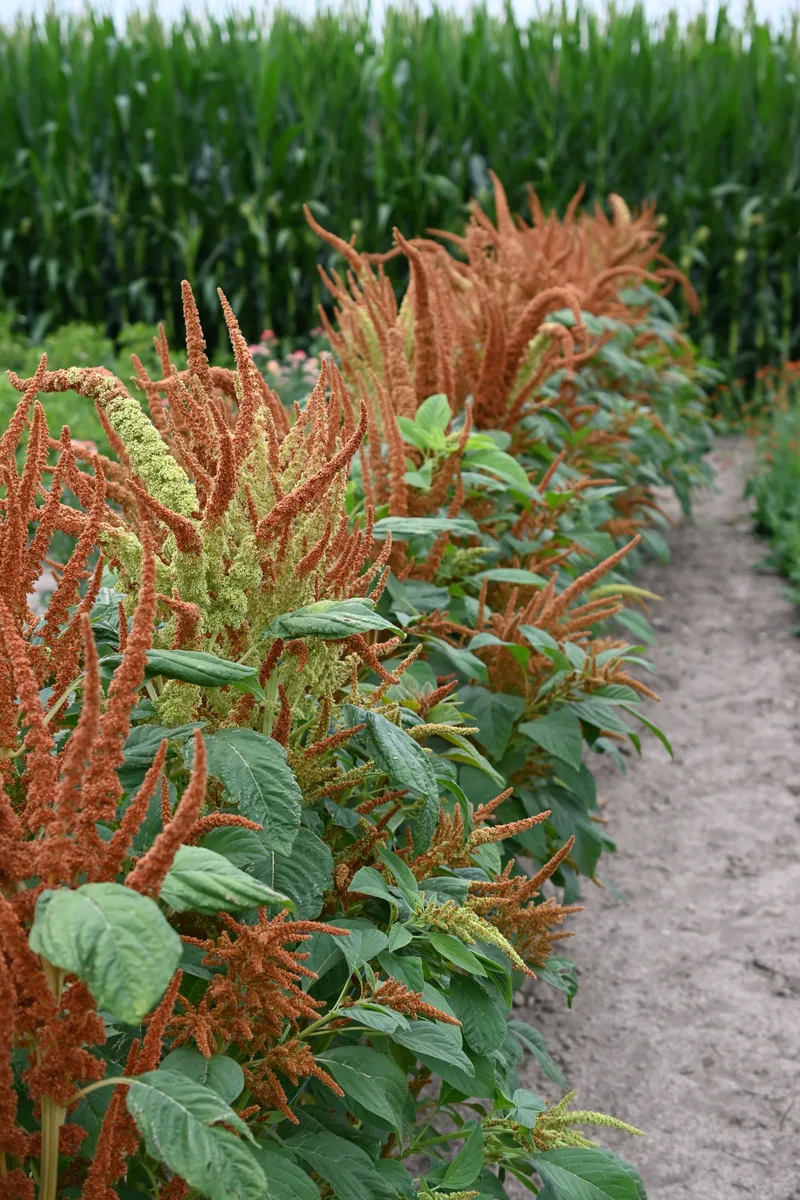
Plants produce feathery spikes of flowers in 'earth' colours such as rust-red, orange, brown and cream, in summer and autumn. Some seed mixtures may have a preponderance of pale colours
Scientific classification
- Species
- prince's feather Autumn Palette Group (Amaranthus cruentus (Autumn Palette Group))
- Genus
- Amaranthus
- Family
- Amaranthaceae
- Order
- Caryophyllales
- Class
- Magnoliopsida
- Phylum
- Magnoliophyta
- Information to be completed
- Toxicity
- Annual Biennial
- Plant type
- 0.5-1 metres
- Height
- 0.5-1 metres
- Spread
- Deciduous
- Foliage
- Bushy
- Habit
- Summer · Autumn
- Season of interest
- Full sun
- Sunlight
- Information to be completed
- Ideal temperature









prince's feather Autumn Palette Group pictures
Distribution of prince's feather Autumn Palette Group
Distribution map
- Native
- Introduced
- Cultivated
Source:WCVP v16 · Royal Botanic Gardens, Kew · CC BY 3.0 · Boundaries:WGSRPD / TDWG
prince's feather Autumn Palette Group care guide
- Frequent light watering, maintain steady moist planting medium
- Watering
- Full sun
- Sunlight

Watering
Frequent light watering, maintain steady moist planting medium
Fertilizing
 Fertilizing
Annual flower balanced feed every two weeks warm growth time
Pruning
 Pruning
Remove plants grown as summer bedding after flowering
Propagation
 Propagation
Propagate by seed sown at 20C (68F) in mid-spring
Growing
 Growing
Under glass grow in loam based compost (JI No2) in full light. Outdoors for summer bedding, grow in moderately fertile, humus-rich, moist soil in full sun in a sheltered site. Water freely during summer to prolong flowering
Common pests and diseases
Diseases
May be susceptible to a virus
Pests
May be susceptible to aphids
Explore the plant health library →




