
baby's toes
Also known as: Information to be completed
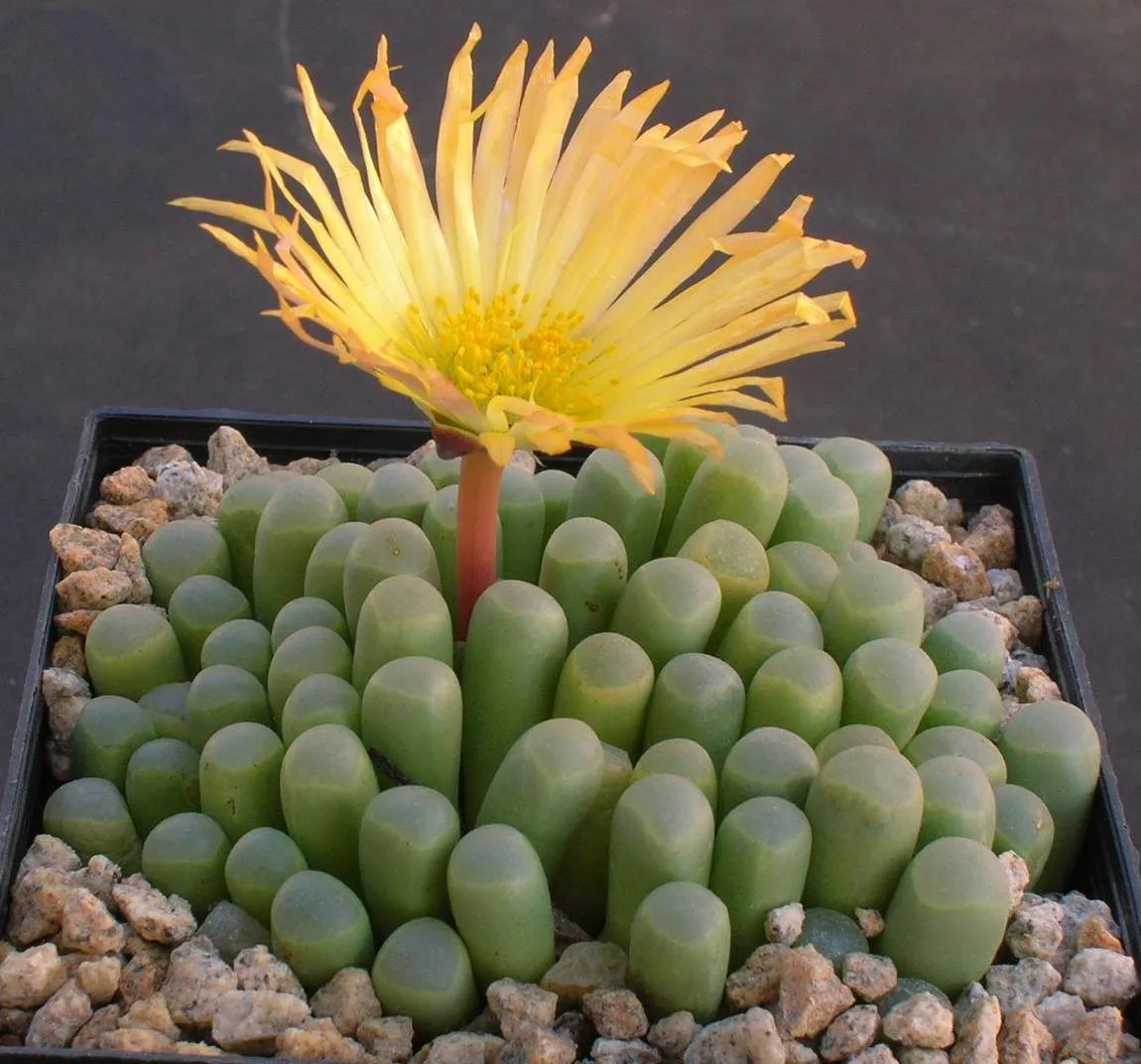
A succulent perennial which grows into a low mat of erect, club-shaped greyish leaves, with daisy-like bright yellow flowers to 7cm across from late summer
Scientific classification
- Species
- baby's toes (Fenestraria rhopalophylla subsp. aurantiaca)
- Genus
- Fenestraria
- Family
- Aizoaceae
- Order
- Caryophyllales
- Class
- Magnoliopsida
- Phylum
- Tracheophyta
- Information to be completed
- Toxicity
- Cactus Succulent · Houseplants · Conservatory Greenhouse
- Plant type
- Up to 10 cm
- Height
- 0.1-0.5 metres
- Spread
- Evergreen
- Foliage
- Clump forming
- Habit
- Spring · Summer · Autumn · Winter
- Season of interest
- Full sun
- Sunlight
- Information to be completed
- Ideal temperature









baby's toes pictures
Distribution of baby's toes
Distribution map
- Native
- Introduced
- Cultivated
Source:WCVP v16 · Royal Botanic Gardens, Kew · CC BY 3.0 · Boundaries:WGSRPD / TDWG
baby's toes care guide
- Water only when substrate fully dry, near zero irrigation cold winter
- Watering
- Full sun
- Sunlight

Watering
Water only when substrate fully dry, near zero irrigation cold winter
Fertilizing
 Fertilizing
Highly diluted low-nitrogen succulent feed monthly warm months
Pruning
 Pruning
No pruning required
Propagation
 Propagation
Propagate by seed or offsets
Growing
 Growing
Grow under glass in a standard cactus compost, in full light. Provide low humidity. Water freely when in growth and keep just moist at other times. Apply a dilute low nitrogen fertilizer fortnightly during late spring and summer. Stand outside in summer
Common pests and diseases
Diseases
Generally disease free
Pests
Mealybugs may be a problem
Explore the plant health library →




