
chenille plant 'Frosty'
Also known as: Information to be completed
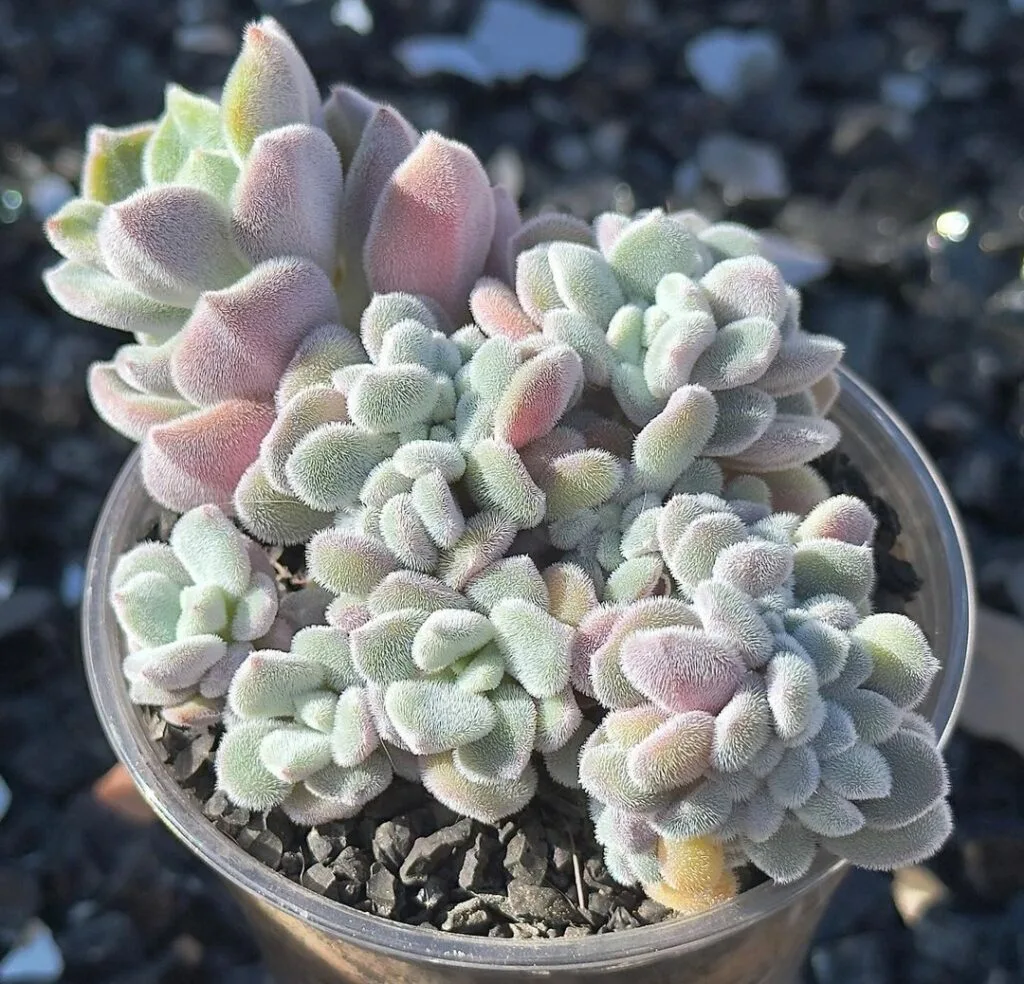
An evergreen succulent with rosettes of white, spoon-shaped velvety leaves with pointed tips. It may produce tube-shaped red-orange flowers which are a paler orange at the base
Scientific classification
- Species
- chenille plant 'Frosty' (Echeveria pulvinata 'Frosty')
- Genus
- Echeveria
- Family
- Crassulaceae
- Order
- Saxifragales
- Class
- Magnoliopsida
- Phylum
- Magnoliophyta
- Information to be completed
- Toxicity
- Cactus Succulent · Conservatory Greenhouse
- Plant type
- 0.1-0.5 metres
- Height
- 0.1-0.5 metres
- Spread
- Evergreen
- Foliage
- Bushy
- Habit
- Spring · Summer · Autumn · Winter
- Season of interest
- Full sun
- Sunlight
- Information to be completed
- Ideal temperature









chenille plant 'Frosty' pictures
Distribution of chenille plant 'Frosty'
Distribution map
- Native
- Introduced
- Cultivated
Source:WCVP v16 · Royal Botanic Gardens, Kew · CC BY 3.0 · Boundaries:WGSRPD / TDWG
chenille plant 'Frosty' care guide
- Let gritty soil dry fully before each thorough watering cycle
- Watering
- Full sun
- Sunlight

Watering
Let gritty soil dry fully before each thorough watering cycle
Fertilizing
 Fertilizing
Very dilute low-nitrogen succulent feed monthly in warm growth
Pruning
 Pruning
No pruning required
Propagation
 Propagation
Propagate by stem or leaf cuttings in spring or early summer. Separate offsets in spring
Growing
 Growing
Grow under glass in a standard cactus compost, in bright, filtered light. When in growth water moderately and feed every two or three weeks with a balanced liquid feed. Keep almost dry in the winter. Stand plants outside during the summer months
Common pests and diseases
Diseases
Generally disease-free
Pests
May be susceptible to mealybugs, vine weevil and aphids
Explore the plant health library →




