
oak 'Koster'
Also known as: oak 'Fastigiata Koster'
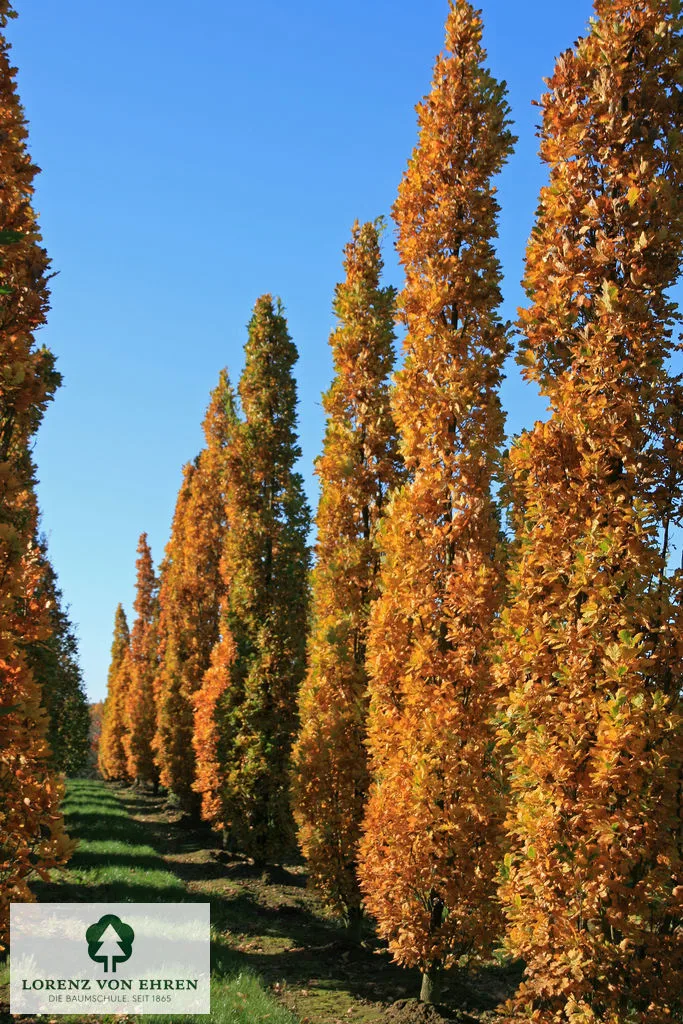
A fastigiate form with upright branches, spreading with age to ultimately reach approximately 20m high and 3m wide. Usually seed-raised so can be variable. Leaves are dark green with shallow lobes
Scientific classification
- Species
- oak 'Koster' (Quercus robur 'Koster')
- Genus
- Quercus
- Family
- Fagaceae
- Information to be completed
- Toxicity
- Trees
- Plant type
- Higher than 12 metres
- Height
- 1.5-2.5 metres
- Spread
- Deciduous
- Foliage
- Columnar upright
- Habit
- Autumn · Spring · Summer
- Season of interest
- Full sun · Partial shade
- Sunlight
- Information to be completed
- Ideal temperature









oak 'Koster' pictures
Distribution of oak 'Koster'
Distribution map
Information to be completed
Information to be completed
Culture
Information to be completed
Toxicity
Information to be completed
Quick identification of oak 'Koster'
Information to be completed
oak 'Koster' care guide
- Moderate regular watering, avoid prolonged drought or waterlogging
- Watering
- Full sun · Partial shade
- Sunlight
- Information to be completed
- Ideal temperature

Watering
Moderate regular watering, avoid prolonged drought or waterlogging
Fertilizing
 Fertilizing
Balanced feed in spring and light repeat in growth season
Pruning
 Pruning
Little pruning is needed. Remove diseased, damaged, crowded or crossing shoots and unwanted growth. Timing depends on the plant: generally late winter or early spring; plants prone to bleeding and deciduous magnolias need different timing, and deciduous azaleas and lilacs are pruned after flowering.
Propagation
 Propagation
Propagate by seed, sown as soon as ripe, in a cold frame
Growing
 Growing
Grows well in most deep, fertile soils and is lime tolerant
People also ask
Information to be completed
Common pests and diseases
Diseases
May be susceptible to powdery mildews and honey fungus
Pests
May be susceptible to oak processionary moth, aphids, caterpillars, leaf-mining moths and oak gall wasps
Explore the plant health library →




