
Cornus kousa 'Teresa'
Also known as: Information to be completed
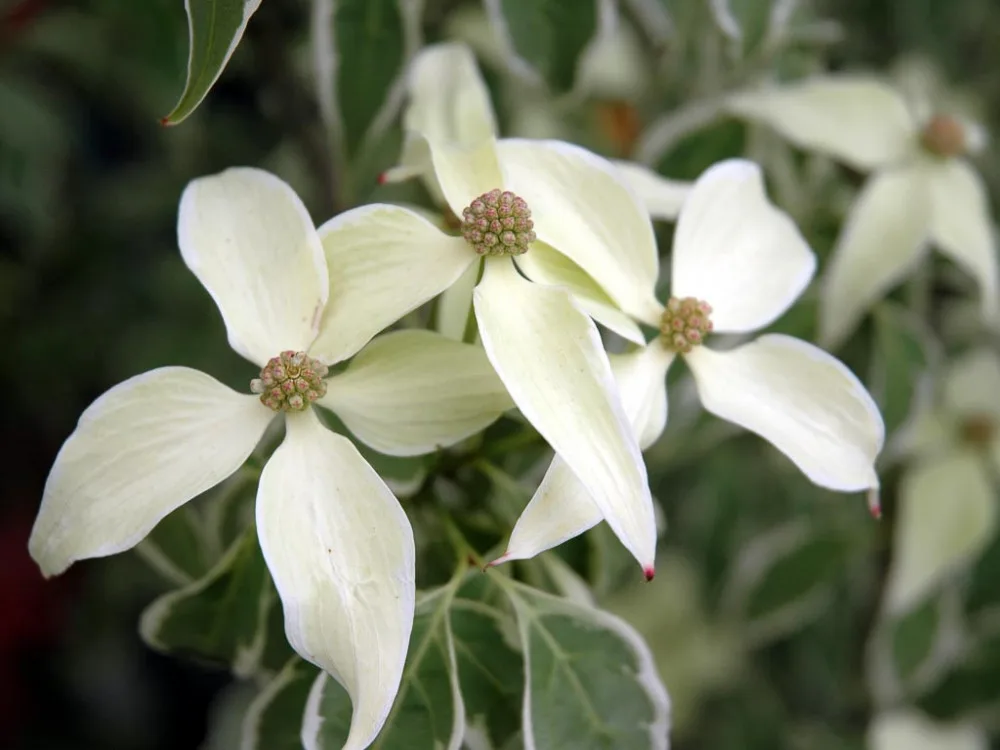
An elegant shrub to 3m in height. Leaves slender, narrow, pointed, variegated, bright green, evenly and narrowly edged with white, with good red and orange colour in autumn. In summer white petal-like bracts are elegantly narrow at tips and base with small central flowerhead. Red strawberry-like fruits follow in autumn.
Scientific classification
- Species
- Cornus kousa 'Teresa' (Cornus kousa 'Teresa')
- Genus
- Cornus
- Family
- Cornaceae
- Order
- Cornales
- Class
- Magnoliopsida
- Phylum
- Tracheophyta
- Information to be completed
- Toxicity
- Shrubs · Trees
- Plant type
- 2.5-4 metres
- Height
- 2.5-4 metres
- Spread
- Deciduous
- Foliage
- Bushy
- Habit
- Autumn · Summer
- Season of interest
- Full sun · Partial shade
- Sunlight
- Information to be completed
- Ideal temperature









Cornus kousa 'Teresa' pictures
Distribution of Cornus kousa 'Teresa'
Distribution map
- Native
- Introduced
- Cultivated
Source:WCVP v16 · Royal Botanic Gardens, Kew · CC BY 3.0 · Boundaries:WGSRPD / TDWG
Cornus kousa 'Teresa' care guide
- Deep watering during hot dry spells, mulch for stable moisture
- Watering
- Full sun · Partial shade
- Sunlight

Watering
Deep watering during hot dry spells, mulch for stable moisture
Fertilizing
 Fertilizing
Balanced dogwood tree fertilizer applied once each early spring
Pruning
 Pruning
Little pruning is needed. Remove diseased, damaged, crowded or crossing shoots and unwanted growth. Timing depends on the plant: generally late winter or early spring; plants prone to bleeding and deciduous magnolias need different timing, and deciduous azaleas and lilacs are pruned after flowering.
Propagation
 Propagation
Propagate by semi-hardwood or hardwood cuttings or grafting
Growing
 Growing
Grow in fertile, humus-rich, well-drained, neutral to acid soil in sun or light shade. For more advice, see flowering dogwood cultivation
Common pests and diseases
Diseases
May be susceptible to cornus anthracnose and honey fungus
Pests
Generally pest-free but may be susceptible to horse chestnut scale
Explore the plant health library →




