
Dionaea muscipula 'South West Giant'
Also known as: Information to be completed
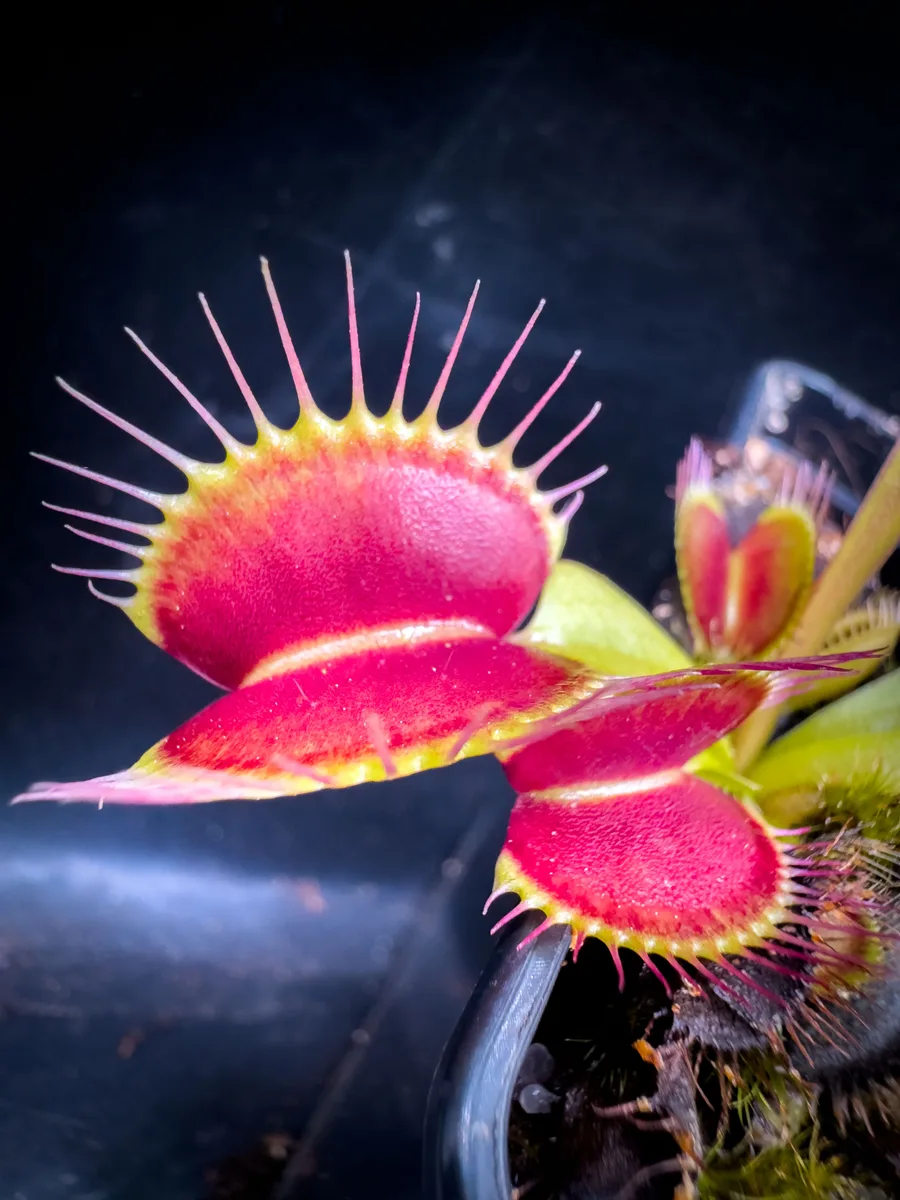
An insectivorous perennial forming rosettes to 30cm wide. The leaves are formed of hinged lobes to 6cm long, with 15-20 stiff spines at the margins; these interlock when the trap closes. The traps are yellow-green on the outside and flushed burgundy on the inside. White flowers to 1cm across are produced on slender stems above the foliage in early summer.
Scientific classification
- Species
- Dionaea muscipula 'South West Giant' (Dionaea muscipula 'South West Giant')
- Genus
- Dionaea
- Family
- Droseraceae
- Order
- Caryophyllales
- Class
- Magnoliopsida
- Phylum
- Magnoliophyta
- Information to be completed
- Toxicity
- Information to be completed
- Plant type
- 0.1-0.5 metres
- Height
- 0.1-0.5 metres
- Spread
- Semi evergreen
- Foliage
- Matforming
- Habit
- Spring · Summer · Autumn
- Season of interest
- Full sun
- Sunlight
- Information to be completed
- Ideal temperature









Dionaea muscipula 'South West Giant' pictures
Distribution of Dionaea muscipula 'South West Giant'
Distribution map
- Native
- Introduced
- Cultivated
Source:WCVP v16 · Royal Botanic Gardens, Kew · CC BY 3.0 · Boundaries:WGSRPD / TDWG
Dionaea muscipula 'South West Giant' care guide
- Moderate regular watering, avoid prolonged drought or waterlogging
- Watering
- Full sun
- Sunlight

Watering
Moderate regular watering, avoid prolonged drought or waterlogging
Fertilizing
 Fertilizing
Balanced feed in spring and light repeat in growth season
Pruning
 Pruning
No pruning required
Propagation
 Propagation
Propagate by sowing seed at 10-13°C in spring; place the container in a water tray to keep the growing medium moist. Germination is often very slow. Divide in spring, or take leaf cuttings in late spring or early summer
Growing
 Growing
Grow in spent, peat-free ericaceous or specialist carnivorous plant compost in a sunny position, either under glass or in a bog garden. If pot grown, stand the containers in trays of rain water to keep the growing medium wet. Water only with soft (ideally rain) water; fertilising is unnecessary. See carnivorous plant cultivation for further information
Common pests and diseases
Diseases
Generally disease-free
Pests
Generally pest-free
Explore the plant health library →




