
peony 'Amabilis'
Also known as: Information to be completed
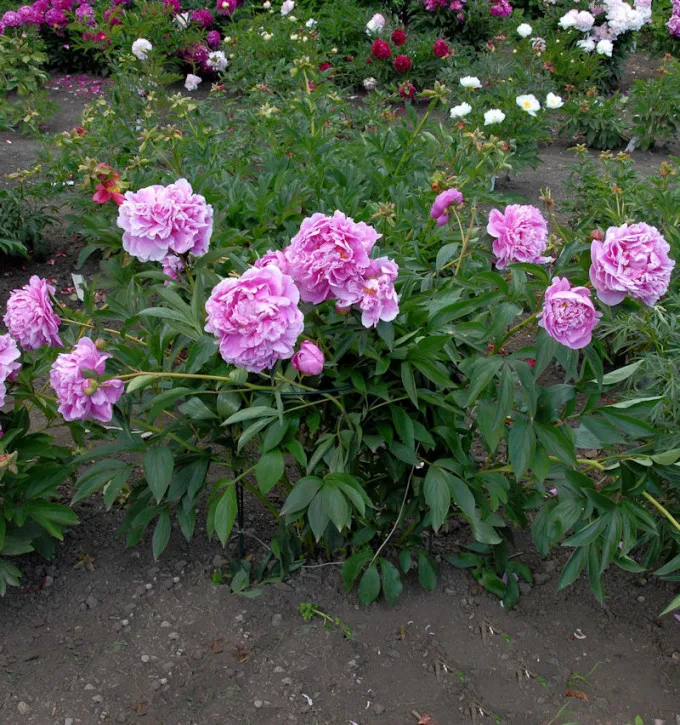
An upright, clump-forming perennial to around 1m tall with mid-green, divided foliage and sweetly-scented, dusky pink double flowers borne from mid- to late spring
Scientific classification
- Species
- peony 'Amabilis' (Paeonia lactiflora 'Amabilis')
- Genus
- Paeonia
- Family
- Paeoniaceae
- Order
- Saxifragales
- Class
- Magnoliopsida
- Phylum
- Magnoliophyta
- Information to be completed
- Toxicity
- Herbaceous Perennial
- Plant type
- 0.5-1 metres
- Height
- 0.5-1 metres
- Spread
- Deciduous
- Foliage
- Clump forming
- Habit
- Spring · Summer · Autumn
- Season of interest
- Full sun · Partial shade
- Sunlight
- Information to be completed
- Ideal temperature









peony 'Amabilis' pictures
Distribution of peony 'Amabilis'
Distribution map
- Native
- Introduced
- Cultivated
Source:WCVP v16 · Royal Botanic Gardens, Kew · CC BY 3.0 · Boundaries:WGSRPD / TDWG
peony 'Amabilis' care guide
- Moderate regular watering, avoid prolonged drought and stagnant waterlogging
- Watering
- Full sun · Partial shade
- Sunlight

Watering
Moderate regular watering, avoid prolonged drought and stagnant waterlogging
Fertilizing
 Fertilizing
Balanced perennial feed every four weeks spring through summer growth
Pruning
 Pruning
Remove dead flowers as they fade, then cut back plant as the foliage dies down in autumn
Propagation
 Propagation
Propagate by division in autumn or early spring
Growing
 Growing
Best in a deep, fertile, humus-rich soil that is moist but well-drained in a sheltered position in full sun or partial shade. May need support (see staking perennials). See herbaceous peony cultivation
Common pests and diseases
Diseases
May be susceptible to a virus, honey fungus, Verticillium wilt, peony leaf blotch and peony wilt
Pests
May be susceptible to leaf and bud eelworm and soil-dwelling swift moth larvae
Explore the plant health library →




