
primrose 'Avondale'
Also known as: Information to be completed
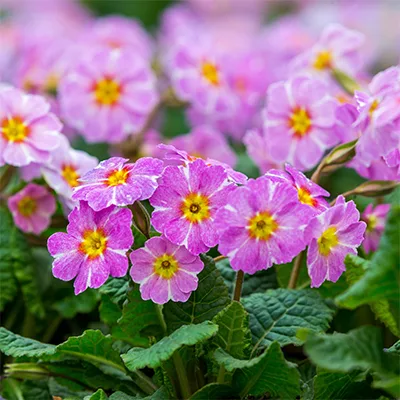
A semi-evergreen, clump-forming perennial to 15cm tall with a rosette of wrinkled, green, oblong leaves. The pink spring flowers have a white line at the centre of each petal and golden-yellow eyes edged with red ring
Scientific classification
- Species
- primrose 'Avondale' (Primula vulgaris 'Avondale')
- Genus
- Primula
- Family
- Primulaceae
- Order
- Ericales
- Class
- Magnoliopsida
- Phylum
- Magnoliophyta
- Information to be completed
- Toxicity
- Alpine Rockery · Herbaceous Perennial
- Plant type
- 0.1-0.5 metres
- Height
- 0.1-0.5 metres
- Spread
- Semi evergreen
- Foliage
- Bushy
- Habit
- Spring · Summer · Autumn · Winter
- Season of interest
- Full sun · Partial shade
- Sunlight
- Information to be completed
- Ideal temperature









primrose 'Avondale' pictures
Distribution of primrose 'Avondale'
Distribution map
- Native
- Introduced
- Cultivated
Locally extinct or doubtful records are excluded from native and introduced layers.
Source:WCVP v16 · Royal Botanic Gardens, Kew · CC BY 3.0 · Boundaries:WGSRPD / TDWG
primrose 'Avondale' care guide
- Moderate regular watering, allowing brief slight drying between soakings
- Watering
- Full sun · Partial shade
- Sunlight

Watering
Moderate regular watering, allowing brief slight drying between soakings
Fertilizing
 Fertilizing
Balanced perennial feed every four weeks from spring through summer
Pruning
 Pruning
No pruning required
Propagation
 Propagation
Propagate by division, or separating and rooting offsets, between autumn and spring
Growing
 Growing
Grow in moist but well-drained, humus-rich soil in sun or part shade
Common pests and diseases
Diseases
May be susceptible to primula brown core, grey moulds, primula leaf spot and a virus
Pests
May be susceptible to aphids, vine weevil, slugs, leaf and bud eelworms, leaf-mining flies and glasshouse red spider mite
Explore the plant health library →




