
Sarracenia × mitchelliana 'Victoria Morley'
Also known as: Information to be completed
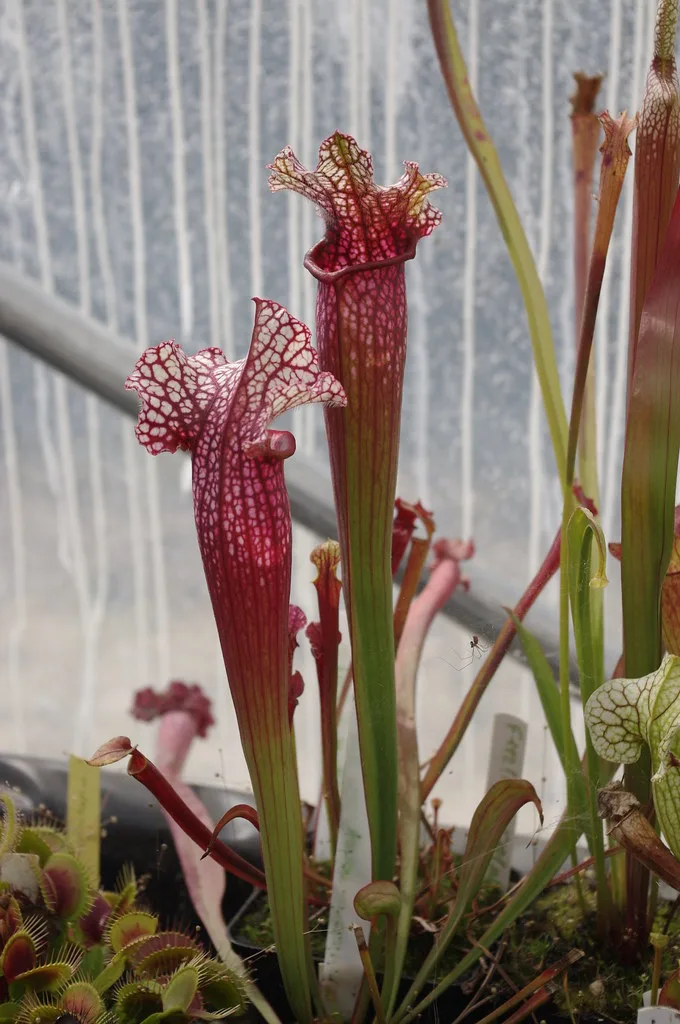
A carnivorous perennial, with upright pitchers produced in spring, almost continuously in summer, and in autumn: they are 35-45 cm high on mature plants, with mouths up to 4 cm wide, the front lips of the mouths turned down, and above them lids up to 8cm across with frilly, upturned edges, and the pitchers are white veined with green and pale pink at first, then darken from the lid downwards until the lids are deep red and the pitchers are deep purple with pink patches; small red flowers appear in spring
Scientific classification
- Species
- Sarracenia × mitchelliana 'Victoria Morley' (Sarracenia × mitchelliana 'Victoria Morley')
- Genus
- Sarracenia
- Family
- Sarraceniaceae
- Order
- Ericales
- Class
- Magnoliopsida
- Phylum
- Tracheophyta
- Information to be completed
- Toxicity
- Herbaceous Perennial
- Plant type
- 0.1-0.5 metres
- Height
- 0.1-0.5 metres
- Spread
- Deciduous
- Foliage
- Clump forming
- Habit
- Spring · Summer · Autumn
- Season of interest
- Full sun
- Sunlight
- Information to be completed
- Ideal temperature









Sarracenia × mitchelliana 'Victoria Morley' pictures
Distribution of Sarracenia × mitchelliana 'Victoria Morley'
Distribution map
- Native
- Introduced
- Cultivated
Source:WCVP v16 · Royal Botanic Gardens, Kew · CC BY 3.0 · Boundaries:WGSRPD / TDWG
Sarracenia × mitchelliana 'Victoria Morley' care guide
- Keep medium constantly wet with pure or rain water only
- Watering
- Full sun
- Sunlight

Watering
Keep medium constantly wet with pure or rain water only
Fertilizing
 Fertilizing
No regular fertilizer needed, avoid standard plant feeding entirely
Pruning
 Pruning
No pruning required
Propagation
 Propagation
Propagate by division in spring
Growing
 Growing
Outdoors, grow in humus-rich, moist, but sharply drained acidic soil in full sun, and if they need watering use lime-free rainwater; under glass, grow in 3 parts sphagnum moss and 1 part each leaf mould and lime-free coarse sand or grit, in full light with shade from hot sun; in summer, stand containers in trays of lime-free water, and apply a balanced liquid fertilizer once a month; in winter, keep just moist, cool, and well ventilated; for more advice, see carnivorous plant cultivation
Common pests and diseases
Diseases
Generally disease-free
Pests
May be affected by scale insects, mealybugs, aphids, and tortix moth caterpillars
Explore the plant health library →




