
Primula vulgaris 'Avoca'
Also known as: Information to be completed
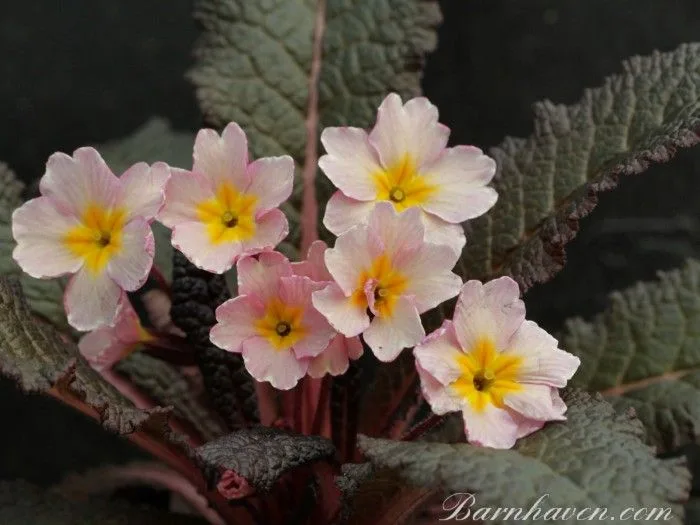
A compact, clump-forming, evergreen perennial producing dark chocolate brown-green foliage with a purple hue. Pale pink to pale purple flowers with bright yellow centres appear from early to late spring. An impressive addition to pots and containers
Scientific classification
- Species
- Primula vulgaris 'Avoca' (Primula vulgaris 'Avoca')
- Genus
- Primula
- Family
- Primulaceae
- Order
- Ericales
- Class
- Magnoliopsida
- Phylum
- Magnoliophyta
- Information to be completed
- Toxicity
- Herbaceous Perennial
- Plant type
- 0.1-0.5 metres
- Height
- 0.1-0.5 metres
- Spread
- Evergreen
- Foliage
- Clump forming
- Habit
- Spring · Summer · Autumn · Winter
- Season of interest
- Partial shade
- Sunlight
- Information to be completed
- Ideal temperature









Primula vulgaris 'Avoca' pictures
Distribution of Primula vulgaris 'Avoca'
Distribution map
- Native
- Introduced
- Cultivated
Locally extinct or doubtful records are excluded from native and introduced layers.
Source:WCVP v16 · Royal Botanic Gardens, Kew · CC BY 3.0 · Boundaries:WGSRPD / TDWG
Primula vulgaris 'Avoca' care guide
- Cool humus soil lightly damp, avoid both drought and stagnant water
- Watering
- Partial shade
- Sunlight

Watering
Cool humus soil lightly damp, avoid both drought and stagnant water
Fertilizing
 Fertilizing
Thin primrose nutrient liquid once monthly growing active months
Pruning
 Pruning
No pruning required
Propagation
 Propagation
Propagate by division in autumn or after flowering
Growing
 Growing
Grow in full sun or partial shade in moderately fertile, moist but well-drained, humus-rich soil
Common pests and diseases
Diseases
May be susceptible to primula leaf spot, primula brown core and grey moulds
Pests
May be susceptible to aphids, vine weevil, slugs, leaf and bud eelworms, leaf-mining flies and glasshouse red spider mite
Explore the plant health library →




