
foxglove 'Sugar Plum'
Also known as: Information to be completed
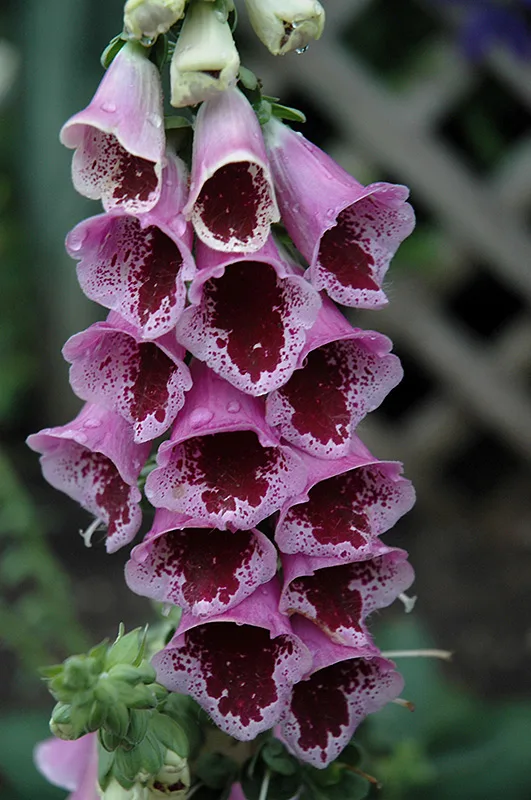
A semi-evergreen biennial or short-lived perennial, to 1.2m high in flower, with ovate to lance-shaped dark green leaves. Tall spikes bear nodding, tubular to bell-shaped pale pink flowers with deep reddish-purple blotches in the throats, from early to late summer
Scientific classification
- Species
- foxglove 'Sugar Plum' (Digitalis purpurea 'Sugar Plum')
- Genus
- Digitalis
- Family
- Plantaginaceae
- Order
- Lamiales
- Class
- Magnoliopsida
- Phylum
- Magnoliophyta
- TOXIC if eaten. Wear gloves and other protective equipment when handling
- Toxicity
- Herbaceous Perennial · Annual Biennial
- Plant type
- 1-1.5 metres
- Height
- 0.1-0.5 metres
- Spread
- Semi evergreen
- Foliage
- Bushy · Columnar upright
- Habit
- Spring · Summer · Autumn · Winter
- Season of interest
- Full sun · Partial shade
- Sunlight
- Information to be completed
- Ideal temperature









foxglove 'Sugar Plum' pictures
Distribution of foxglove 'Sugar Plum'
Distribution map
- Native
- Introduced
- Cultivated
Source:WCVP v16 · Royal Botanic Gardens, Kew · CC BY 3.0 · Boundaries:WGSRPD / TDWG
Toxicity
TOXIC if eaten. Wear gloves and other protective equipment when handling
foxglove 'Sugar Plum' care guide
- Moderate regular watering, allowing brief slight drying between soakings
- Watering
- Full sun · Partial shade
- Sunlight

Watering
Moderate regular watering, allowing brief slight drying between soakings
Fertilizing
 Fertilizing
Balanced perennial feed every four weeks from spring through summer
Pruning
 Pruning
Deadhead to encourage more flowers (unless seeds are required)
Propagation
 Propagation
Propagate by seed, sown in pots in a cold frame in late spring for flowering the following year. Seeds sown in January, in a protected environment at 15-18°C, may produce flowers in late summer of the first year
Growing
 Growing
Will grow in almost any soil or situation except very wet or very dry; ideally a sheltered, warm site with humus-rich soil in light or partial shade. See foxglove cultivation for more detailed advice
Common pests and diseases
Diseases
May be susceptible to powdery mildews, downy mildews and leaf spot
Pests
May be susceptible to aphids, leaf and bud eelworms, slugs and snails
Explore the plant health library →




