
Helleborus lividus 'Purple Ear'
Also known as: Information to be completed
A tender, semi-evergreen, clump forming perennial with divided, leathery, green, marbled foliage and branched stems rising above with clusters of dangling, cup-shaped, creamy green single flowers soflty flushed pale purple in late winter and early spring.
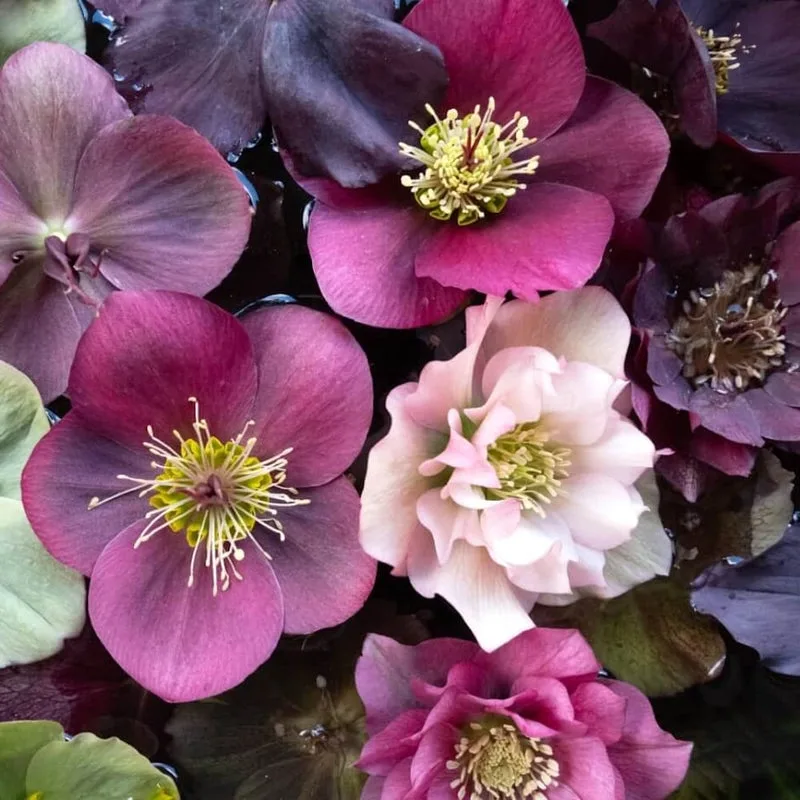
Scientific classification
- Species
- Helleborus lividus 'Purple Ear' (Helleborus lividus 'Purple Ear')
- Genus
- Helleborus
- Family
- Ranunculaceae
- Order
- Ranunculales
- Class
- Magnoliopsida
- Phylum
- Magnoliophyta
- Harmful if eaten, skin irritant. Wear gloves and other protective equipment when handling]
- Toxicity
- Herbaceous Perennial
- Plant type
- 0.1-0.5 metres
- Height
- 0.1-0.5 metres
- Spread
- Semi evergreen · Evergreen
- Foliage
- Clump forming
- Habit
- Spring · Summer · Autumn · Winter
- Season of interest
- Partial shade
- Sunlight
- Information to be completed
- Ideal temperature









Helleborus lividus 'Purple Ear' pictures
Distribution of Helleborus lividus 'Purple Ear'
Distribution map
- Native
- Introduced
- Cultivated
Source:WCVP v16 · Royal Botanic Gardens, Kew · CC BY 3.0 · Boundaries:WGSRPD / TDWG
Toxicity
Harmful if eaten, skin irritant. Wear gloves and other protective equipment when handling]
Helleborus lividus 'Purple Ear' care guide
- Moderate regular watering, allowing brief slight drying between soakings
- Watering
- Partial shade
- Sunlight

Watering
Moderate regular watering, allowing brief slight drying between soakings
Fertilizing
 Fertilizing
Balanced perennial feed every four weeks from spring through summer
Pruning
 Pruning
Cut back to the ground brown or dead foliage in late winter when flower buds start to develop
Propagation
 Propagation
Propagate by seed or by division in autumn
Growing
 Growing
Prefers a humus-rich, fertile, and moisture-retentive soil in partial shade but will tolerate full sun. Protect from strong, cold winds and mulch with a layer of well-rotted organic matter in autumn. See hellebore cultivation for further information
Common pests and diseases
Diseases
May be susceptible to hellebore leaf spot and hellebore black death
Pests
May be susceptible to hellebore aphid, hellebore leaf miner and snails
Explore the plant health library →




