
lesser celandine 'Collarette'
Also known as: Information to be completed
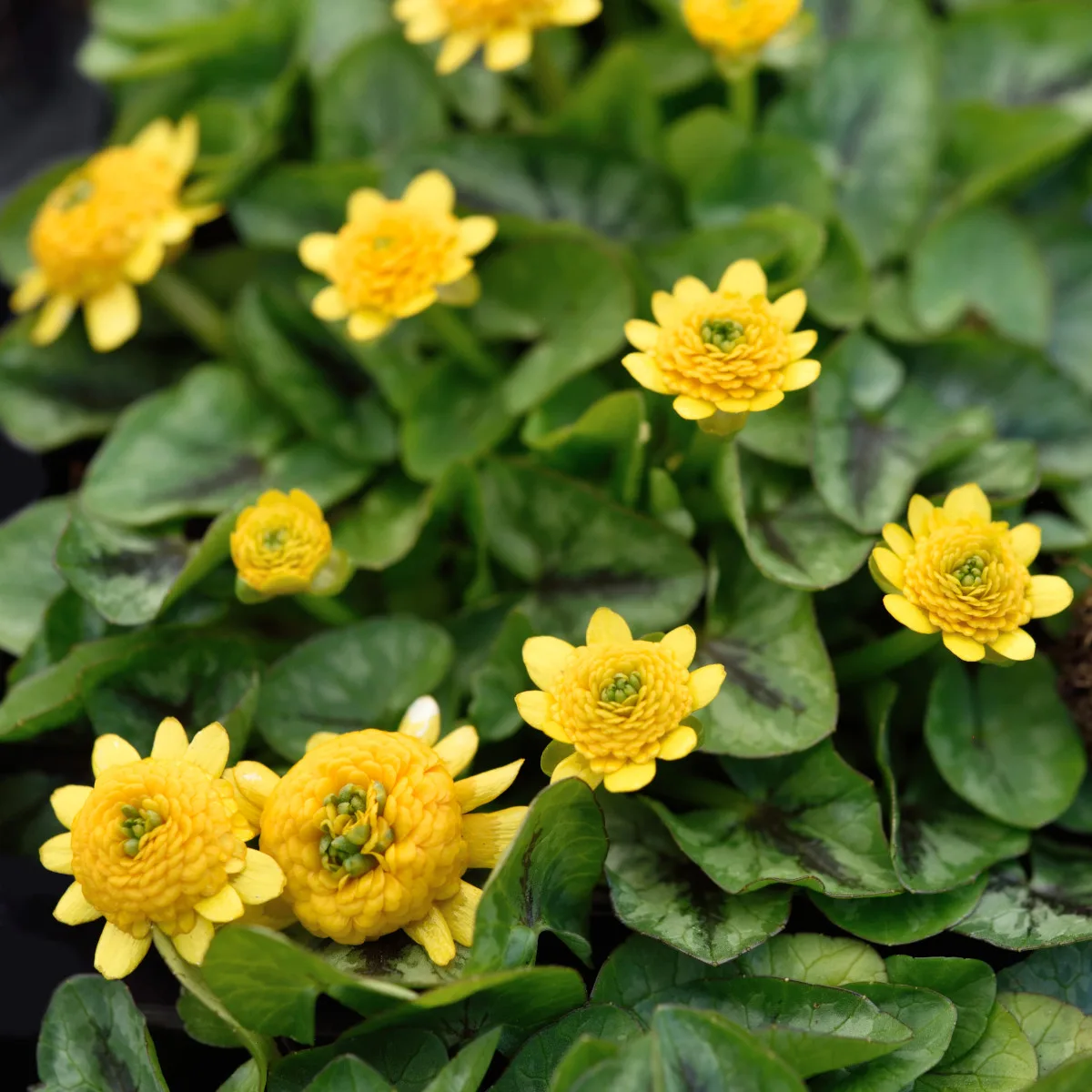
A compact, tuberous-rooted perennial with rosettes of broadly heart-shaped leaves, mid-green with silvery and dark purple markings, appearing from late winter to early summer. Distinctive yellow flowers, with a tight mass of short, central petals, an outer ring of larger petals, and a green eye, open from early spring
Scientific classification
- Species
- lesser celandine 'Collarette' (Ficaria verna 'Collarette')
- Genus
- Ficaria
- Family
- Ranunculaceae
- Order
- Ranunculales
- Class
- Magnoliopsida
- Phylum
- Tracheophyta
- Harmful if eaten, skin irritant. Wear gloves and other protective equipment when handling]
- Toxicity
- Herbaceous Perennial
- Plant type
- Up to 10 cm
- Height
- 0-0.1 metre
- Spread
- Deciduous
- Foliage
- Clump forming
- Habit
- Spring · Summer · Winter
- Season of interest
- Full shade · Partial shade
- Sunlight
- Information to be completed
- Ideal temperature









lesser celandine 'Collarette' pictures
Distribution of lesser celandine 'Collarette'
Distribution map
- Native
- Introduced
- Cultivated
Source:WCVP v16 · Royal Botanic Gardens, Kew · CC BY 3.0 · Boundaries:WGSRPD / TDWG
Toxicity
Harmful if eaten, skin irritant. Wear gloves and other protective equipment when handling]
lesser celandine 'Collarette' care guide
- Moderate regular watering, allowing brief slight drying between soakings
- Watering
- Full shade · Partial shade
- Sunlight

Watering
Moderate regular watering, allowing brief slight drying between soakings
Fertilizing
 Fertilizing
Balanced perennial feed every four weeks from spring through summer
Pruning
 Pruning
No pruning required
Propagation
 Propagation
Propagate by division
Growing
 Growing
Grow in full or partial shade in moist, humus-rich soil. A good early source of pollen and nectar for insects, though plants can spread and have potential to become a nuisance if not controlled. See celandine cultivation
Common pests and diseases
Diseases
May be susceptible to powdery mildews
Pests
May be susceptible to slugs, snails and aphids
Explore the plant health library →




