
Filipendula multijuga 'Hjördis'
Also known as: Information to be completed
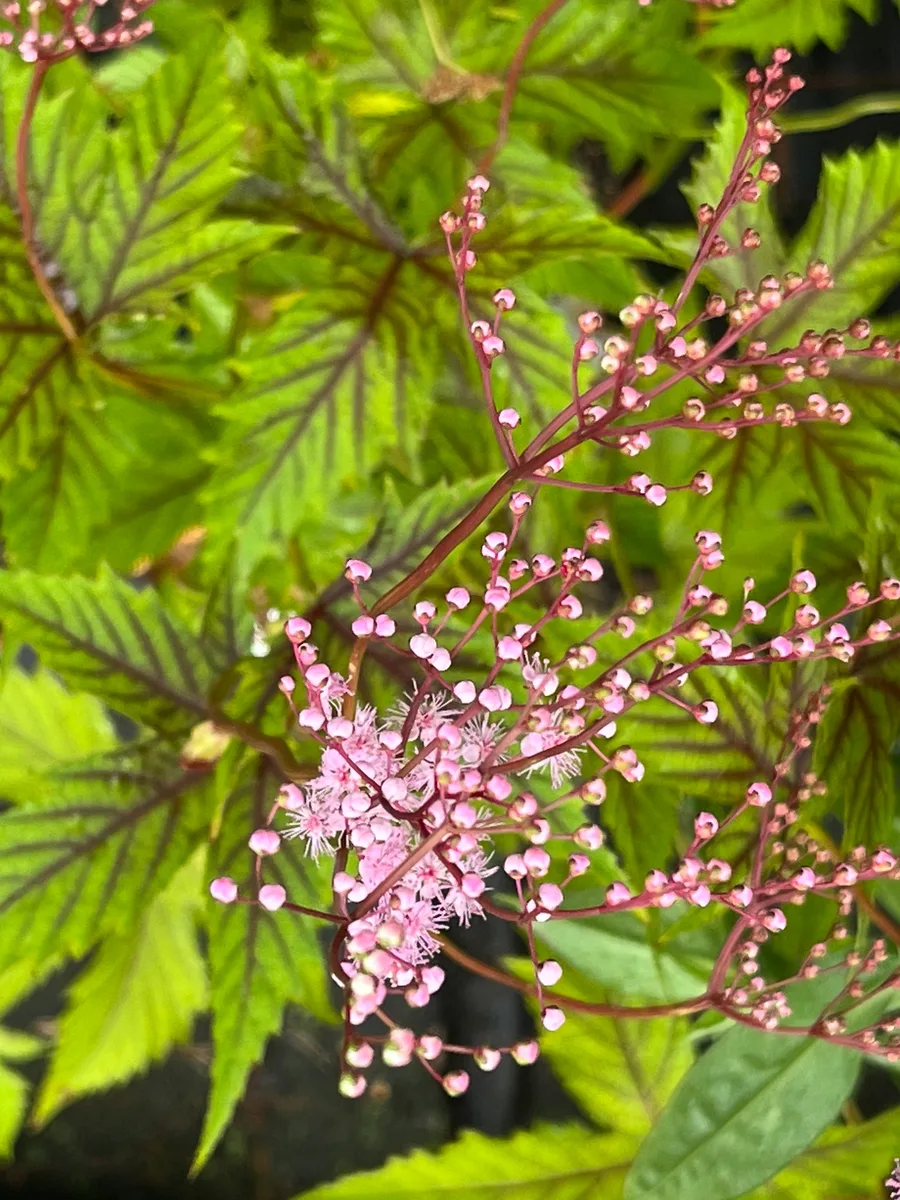
A clump-forming perennial to 80cm tall when in flower, producing bright green, toothed, palmate leaves with bold, maroon veins. From mid to late summer it bears plumes of fluffy, pale pink flowers, held on wiry stems above the foliage
Scientific classification
- Species
- Filipendula multijuga 'Hjördis' (Filipendula multijuga 'Hjördis')
- Genus
- Filipendula
- Family
- Rosaceae
- Information to be completed
- Toxicity
- Herbaceous Perennial
- Plant type
- 0.5-1 metres
- Height
- 0.1-0.5 metres
- Spread
- Deciduous
- Foliage
- Clump forming
- Habit
- Spring · Summer · Autumn
- Season of interest
- Partial shade
- Sunlight
- Information to be completed
- Ideal temperature









Filipendula multijuga 'Hjördis' pictures
Distribution of Filipendula multijuga 'Hjördis'
Distribution map
- Native
- Introduced
- Cultivated
Source:WCVP v16 · Royal Botanic Gardens, Kew · CC BY 3.0 · Boundaries:WGSRPD / TDWG
Culture
Information to be completed
Toxicity
Information to be completed
Quick identification of Filipendula multijuga 'Hjördis'
Information to be completed
Filipendula multijuga 'Hjördis' care guide
- Maintain soft damp soil, drought leads to leaf wilting fast
- Watering
- Partial shade
- Sunlight
- Information to be completed
- Ideal temperature

Watering
Maintain soft damp soil, drought leads to leaf wilting fast
Fertilizing
 Fertilizing
Diluted balanced feed every three weeks warm months
Pruning
 Pruning
Cut back to ground level in early winter
Propagation
 Propagation
Propagate by seed, division or root cuttings
Growing
 Growing
Grow in moderately fertile, leafy, moist but well-drained soil in partial shade. Mulch in spring
People also ask
Information to be completed
Common pests and diseases
Diseases
May be susceptible to Powdery mildews
Pests
Generally pest-free
Explore the plant health library →




