
Californian tailed false hellebore
Also known as: Information to be completed
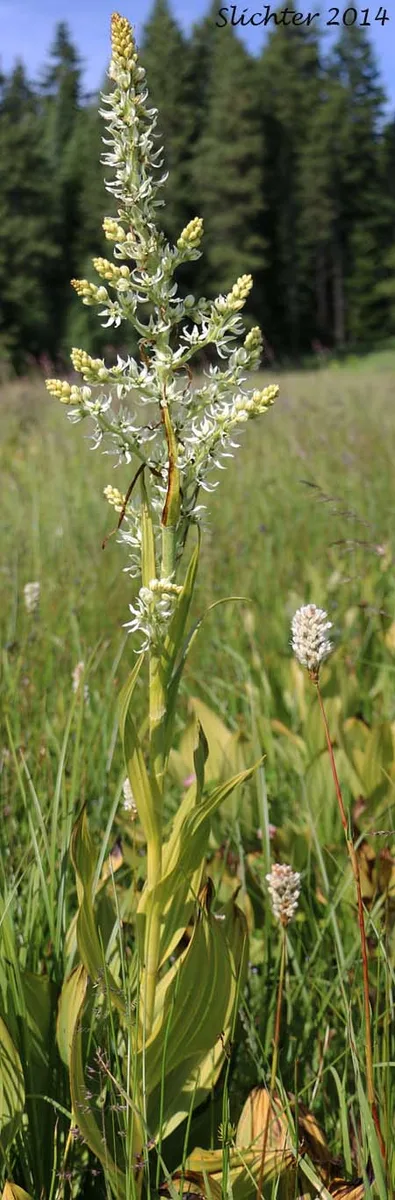
a slow-growing, herbaceous perennial with broad, pleated leaves. The flower stem can reach 2m, has short branches on the lower half, and is clothed in greenish-white, star-shaped flowers in mid- to late summer
Scientific classification
- Species
- Californian tailed false hellebore (Veratrum californicum var. caudatum)
- Genus
- Veratrum
- Family
- Melanthiaceae
- Order
- Liliales
- Class
- Liliopsida
- Phylum
- Magnoliophyta
- TOXIC if eaten. Wear gloves and other protective equipment when handling
- Toxicity
- Herbaceous Perennial
- Plant type
- 1.5-2.5 metres
- Height
- 0.1-0.5 metres
- Spread
- Deciduous
- Foliage
- Clump forming
- Habit
- Spring · Summer
- Season of interest
- Full sun · Partial shade
- Sunlight
- Information to be completed
- Ideal temperature









Californian tailed false hellebore pictures
Distribution of Californian tailed false hellebore
Distribution map
- Native
- Introduced
- Cultivated
Source:WCVP v16 · Royal Botanic Gardens, Kew · CC BY 3.0 · Boundaries:WGSRPD / TDWG
Toxicity
TOXIC if eaten. Wear gloves and other protective equipment when handling
Californian tailed false hellebore care guide
- Maintain evenly moist soil, reduce irrigation supply autumn dormancy
- Watering
- Full sun · Partial shade
- Sunlight

Watering
Maintain evenly moist soil, reduce irrigation supply autumn dormancy
Fertilizing
 Fertilizing
Weak balanced perennial feed once per month spring growing period
Pruning
 Pruning
Cut down flowering spike after flowering
Propagation
 Propagation
Propagate by seed in pots in a cold frame as soon as seed is ripe. Propagate by division in early spring or autumn
Growing
 Growing
Grow in deep, fertile, humus-rich soil that is moist but well-drained; site in partial shade or full sun so long as the soil does not dry out. Shelter from cold, drying winds
Common pests and diseases
Diseases
Generally disease- free
Pests
May be susceptible to slugs and snails
Explore the plant health library →




