
New England aster 'Saint Michael's'
Also known as: Information to be completed
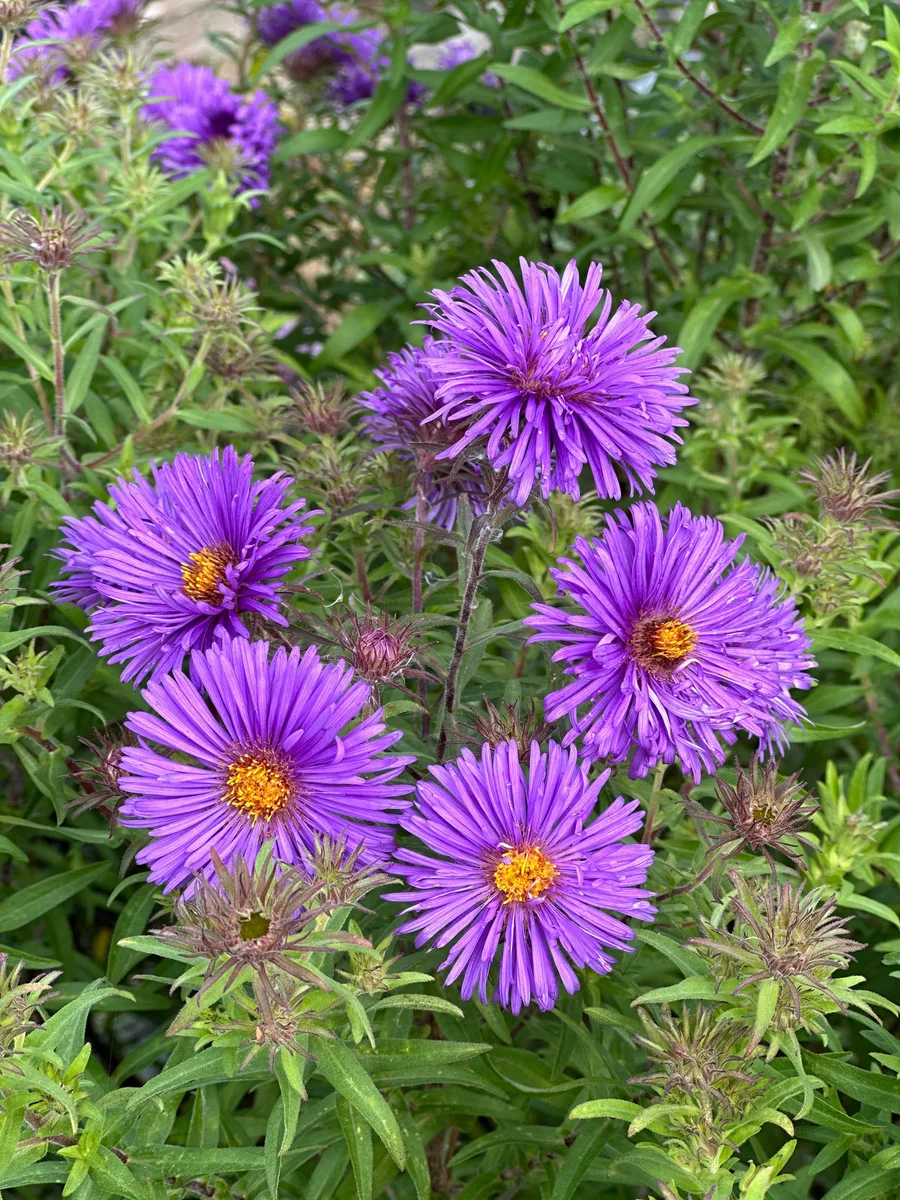
A clump-forming perennial, up to 1.2m high, with upright stems clad in lance-shaped dark green leaves. Clusters of large, daisy-like, pale violet flowers, with fine, narrow petals and golden-yellow central discs, are produced in early autumn
Scientific classification
- Species
- New England aster 'Saint Michael's' (Symphyotrichum novae-angliae 'Saint Michael's')
- Genus
- Symphyotrichum
- Family
- Asteraceae
- Order
- Asterales
- Class
- Magnoliopsida
- Phylum
- Magnoliophyta
- Information to be completed
- Toxicity
- Herbaceous Perennial
- Plant type
- 1-1.5 metres
- Height
- 0.1-0.5 metres
- Spread
- Deciduous
- Foliage
- Bushy
- Habit
- Spring · Summer · Autumn
- Season of interest
- Full sun · Partial shade
- Sunlight
- Information to be completed
- Ideal temperature









New England aster 'Saint Michael's' pictures
Distribution of New England aster 'Saint Michael's'
Distribution map
- Native
- Introduced
- Cultivated
Source:WCVP v16 · Royal Botanic Gardens, Kew · CC BY 3.0 · Boundaries:WGSRPD / TDWG
New England aster 'Saint Michael's' care guide
- Water deeply after surface soil dries, drain all excess water quickly
- Watering
- Full sun · Partial shade
- Sunlight

Watering
Water deeply after surface soil dries, drain all excess water quickly
Fertilizing
 Fertilizing
Phosphorus rich autumn aster feed biweekly before blooming period
Pruning
 Pruning
Cut stems close to the ground in late autumn
Propagation
 Propagation
Propagate by division in spring, replanting only vigorous young shoots
Growing
 Growing
Grow in well-cultivated, fertile, moist but well drained soil in sun or partial shade; mulch every year after cutting down in late autumn. Plants may need support until established, see staking perennials
Common pests and diseases
Diseases
May be susceptible to Fusarium wilt, powdery mildews, leaf spots and grey moulds
Pests
May be susceptible to tarsonemid mite, slugs, snails, aphids, leaf and bud eelworms
Explore the plant health library →




