
pasqueflower [Pinwheel White]
Also known as: Information to be completed
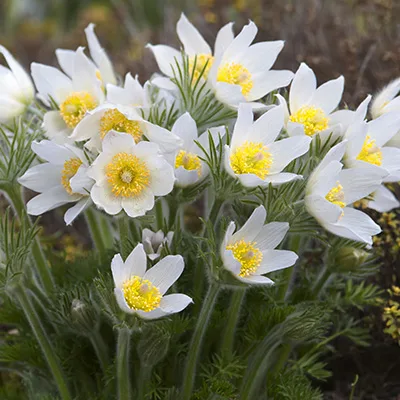
A low-growing, clump-forming herbaceous perennial with green, softly hairy dissected foliage. Pure white, upward-facing, pointed flowers with yellow centres appear from March to April
Scientific classification
- Species
- pasqueflower [Pinwheel White] (Pulsatilla vulgaris Pinwheel White)
- Genus
- Pulsatilla
- Family
- Ranunculaceae
- Order
- Ranunculales
- Class
- Magnoliopsida
- Phylum
- Magnoliophyta
- Can cause mild stomach upset if ingested. Wear gloves and other protective equipment when handling
- Toxicity
- Herbaceous Perennial
- Plant type
- 0.1-0.5 metres
- Height
- 0.1-0.5 metres
- Spread
- Deciduous
- Foliage
- Clump forming
- Habit
- Spring · Summer
- Season of interest
- Full sun
- Sunlight
- Information to be completed
- Ideal temperature









pasqueflower [Pinwheel White] pictures
Toxicity
Can cause mild stomach upset if ingested. Wear gloves and other protective equipment when handling
pasqueflower [Pinwheel White] care guide
- Moderate regular watering, avoid prolonged drought and stagnant waterlogging
- Watering
- Full sun
- Sunlight

Watering
Moderate regular watering, avoid prolonged drought and stagnant waterlogging
Fertilizing
 Fertilizing
Balanced perennial feed every four weeks spring through summer growth
Pruning
 Pruning
Leave faded flowers as seedheads are an attractive feature
Propagation
 Propagation
Propagate by taking root cuttings in winter
Growing
 Growing
Grow in fertile, very well-drained soil in full sun. It resents root disturbance and may be difficult to establish, so plant when small and leave undisturbed. Can also be grown in pots in an alpine house
Common pests and diseases
Diseases
Generally disease-free
Pests
Generally pest-free
Explore the plant health library →




