
October daphne 'Dragon'
Also known as: Information to be completed
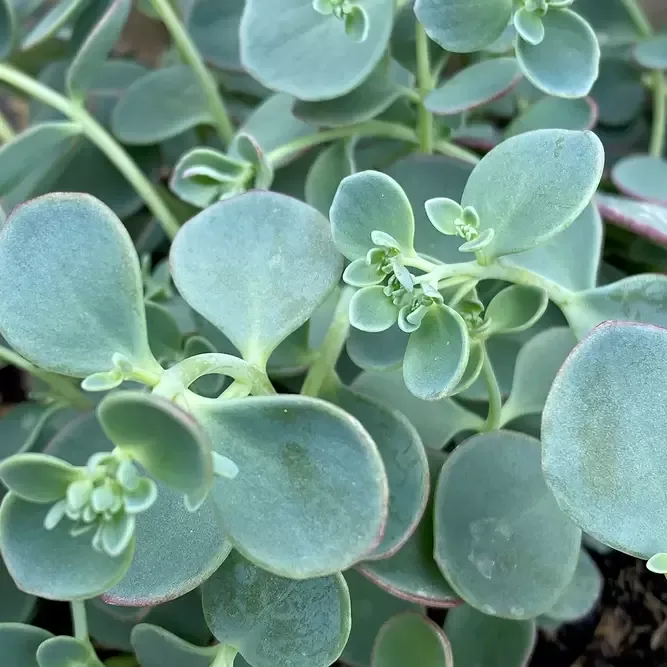
An herbaceous perennial forming a low, spreading clump to 20cm high and 45cm wide, with whorls of 3 rounded fleshy, grey-green leaves, with a narrow red pencil-line edging and terminal clusters of star-shaped, soft pink flowers, in late summer and early autumn
Scientific classification
- Species
- October daphne 'Dragon' (Hylotelephium sieboldii 'Dragon')
- Genus
- Hylotelephium
- Family
- Crassulaceae
- Order
- Saxifragales
- Class
- Magnoliopsida
- Phylum
- Magnoliophyta
- Information to be completed
- Toxicity
- Herbaceous Perennial
- Plant type
- 0.1-0.5 metres
- Height
- 0.1-0.5 metres
- Spread
- Deciduous
- Foliage
- Information to be completed
- Habit
- Spring · Summer · Autumn
- Season of interest
- Full sun · Partial shade
- Sunlight
- Information to be completed
- Ideal temperature









October daphne 'Dragon' pictures
Distribution of October daphne 'Dragon'
Distribution map
- Native
- Introduced
- Cultivated
Source:WCVP v16 · Royal Botanic Gardens, Kew · CC BY 3.0 · Boundaries:WGSRPD / TDWG
October daphne 'Dragon' care guide
- Let gritty substrate dry completely before giving another full soaking
- Watering
- Full sun · Partial shade
- Sunlight

Watering
Let gritty substrate dry completely before giving another full soaking
Fertilizing
 Fertilizing
Ultra-diluted low-nitrogen succulent feed monthly warm summer only
Pruning
 Pruning
May be pruned to shape after flowering
Propagation
 Propagation
Propagate by softwood cuttings of non-flowering shoots in early summer
Growing
 Growing
Grow in moderately fertile well-drained soil in full sun or partial shade and protect from winter wet. Can be grown as a houseplant or in an alpine house in a loam based potting compost with added grit. Water moderately in growth and apply a half-strength liquid fertiliser monthly. Water sparingly in winter
Common pests and diseases
Diseases
Generally disease-free
Pests
May be susceptible to aphids, scale insects, mealybugs and vine weevils
Explore the plant health library →




