
orpine 'Gooseberry Fool'
Also known as: Information to be completed
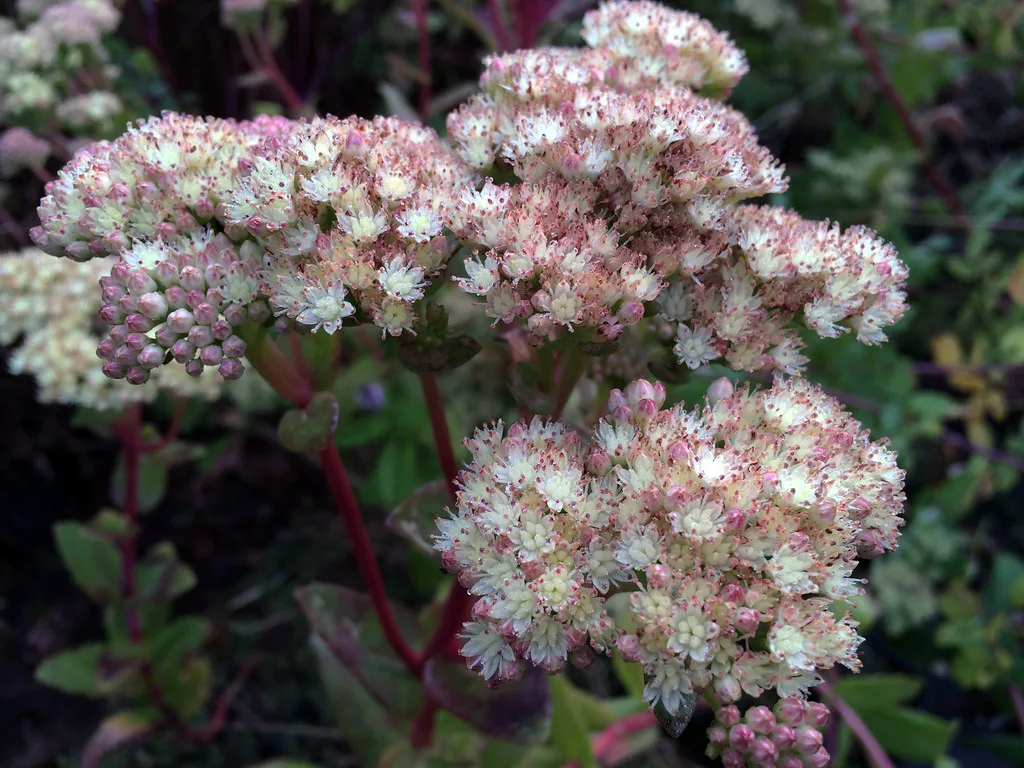
A clump-forming perennial to 60cm tall with grey-green leaves flushed red along the midribs. Flowerheads up to 20cm across comprising greenish to creamy-white flowers are borne from summer into autumn on purplish-red stems
Scientific classification
- Species
- orpine 'Gooseberry Fool' (Hylotelephium telephium subsp. maximum 'Gooseberry Fool')
- Genus
- Hylotelephium
- Family
- Crassulaceae
- Order
- Saxifragales
- Class
- Magnoliopsida
- Phylum
- Magnoliophyta
- May cause mild stomach upset if eaten, contact with sap may irritate skin. Wear gloves and other protective equipment when handling]
- Toxicity
- Herbaceous Perennial
- Plant type
- 0.5-1 metres
- Height
- 0.1-0.5 metres
- Spread
- Deciduous
- Foliage
- Clump forming
- Habit
- Spring · Summer · Autumn
- Season of interest
- Full sun
- Sunlight
- Information to be completed
- Ideal temperature









orpine 'Gooseberry Fool' pictures
Distribution of orpine 'Gooseberry Fool'
Distribution map
- Native
- Introduced
- Cultivated
Source:WCVP v16 · Royal Botanic Gardens, Kew · CC BY 3.0 · Boundaries:WGSRPD / TDWG
Toxicity
May cause mild stomach upset if eaten, contact with sap may irritate skin. Wear gloves and other protective equipment when handling]
orpine 'Gooseberry Fool' care guide
- Let gritty soil dry fully before each thorough watering cycle
- Watering
- Full sun
- Sunlight

Watering
Let gritty soil dry fully before each thorough watering cycle
Fertilizing
 Fertilizing
Very dilute low-nitrogen succulent feed monthly in warm growth
Pruning
 Pruning
Cut back after flowering to maintain shape or leave seedheads to overwinter
Propagation
 Propagation
Propagate by division in spring or by softwood cuttings of non-flowering shoots in early summer
Growing
 Growing
Grow in moderately fertile, well-drained, neutral to slightly alkaline soil in full sun
Common pests and diseases
Diseases
May be subject to fungal and bacterial crown rot and root rots
Pests
Generally pest-free
Explore the plant health library →




