
Lonicera periclymenum 'Strawberries and Cream'
Also known as: Information to be completed
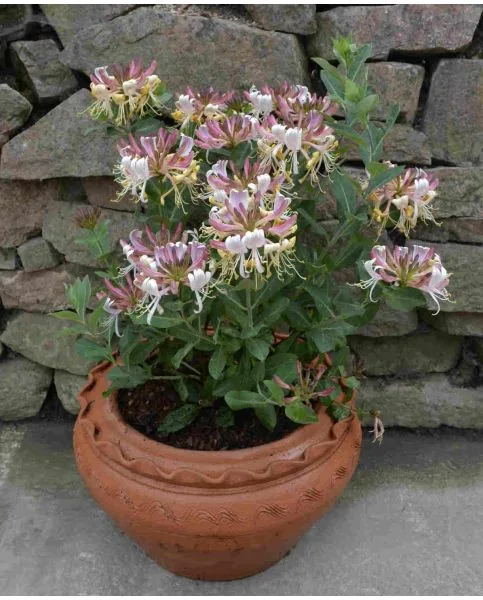
A compact deciduous shrub reaching up to 60cm in height. Leaves undivided, ovate to oblong, in pairs, green with a more glaucous underside. Flowers are intensely fragrant, borne in clusters at the ends of the shoots. Flower buds are purple-pink, opening to pinkish white becoming a buff yellow as the flowers mature.
Scientific classification
- Species
- Lonicera periclymenum 'Strawberries and Cream' (Lonicera periclymenum 'Strawberries and Cream')
- Genus
- Lonicera
- Family
- Caprifoliaceae
- Order
- Dipsacales
- Class
- Magnoliopsida
- Phylum
- Magnoliophyta
- Fruit are ornamental - not to be eaten. Wear gloves and other protective equipment when handling
- Toxicity
- Climber Wall Shrub
- Plant type
- 0.5-1 metres
- Height
- 0.5-1 metres
- Spread
- Deciduous
- Foliage
- Climbing
- Habit
- Spring · Summer · Autumn
- Season of interest
- Full sun · Partial shade
- Sunlight
- Information to be completed
- Ideal temperature









Lonicera periclymenum 'Strawberries and Cream' pictures
Toxicity
Fruit are ornamental - not to be eaten. Wear gloves and other protective equipment when handling
Lonicera periclymenum 'Strawberries and Cream' care guide
- Moderate regular watering, allowing brief slight drying between soakings
- Watering
- Full sun · Partial shade
- Sunlight

Watering
Moderate regular watering, allowing brief slight drying between soakings
Fertilizing
 Fertilizing
Balanced perennial feed every four weeks from spring through summer
Pruning
 Pruning
Routine pruning is unnecessary; shorten overlong shoots to fit the available space. Prune after flowering has finished.
Propagation
 Propagation
Propagate by layering, hardwood cuttings or semi-hardwood cuttings
Growing
 Growing
This compact variety is ideal for small spaces such as containers or for positions near the front of flower borders. Evening scented flowers attracts pollinating moths
Common pests and diseases
Diseases
May be susceptible to powdery mildews, fungal leaf spot, silver leaf and honey fungus (rarely)
Pests
May be susceptible to honeysuckle aphids, Thrips and glasshouse whitefly
Explore the plant health library →




