
marigold 'Snow Princess'
Also known as: Information to be completed
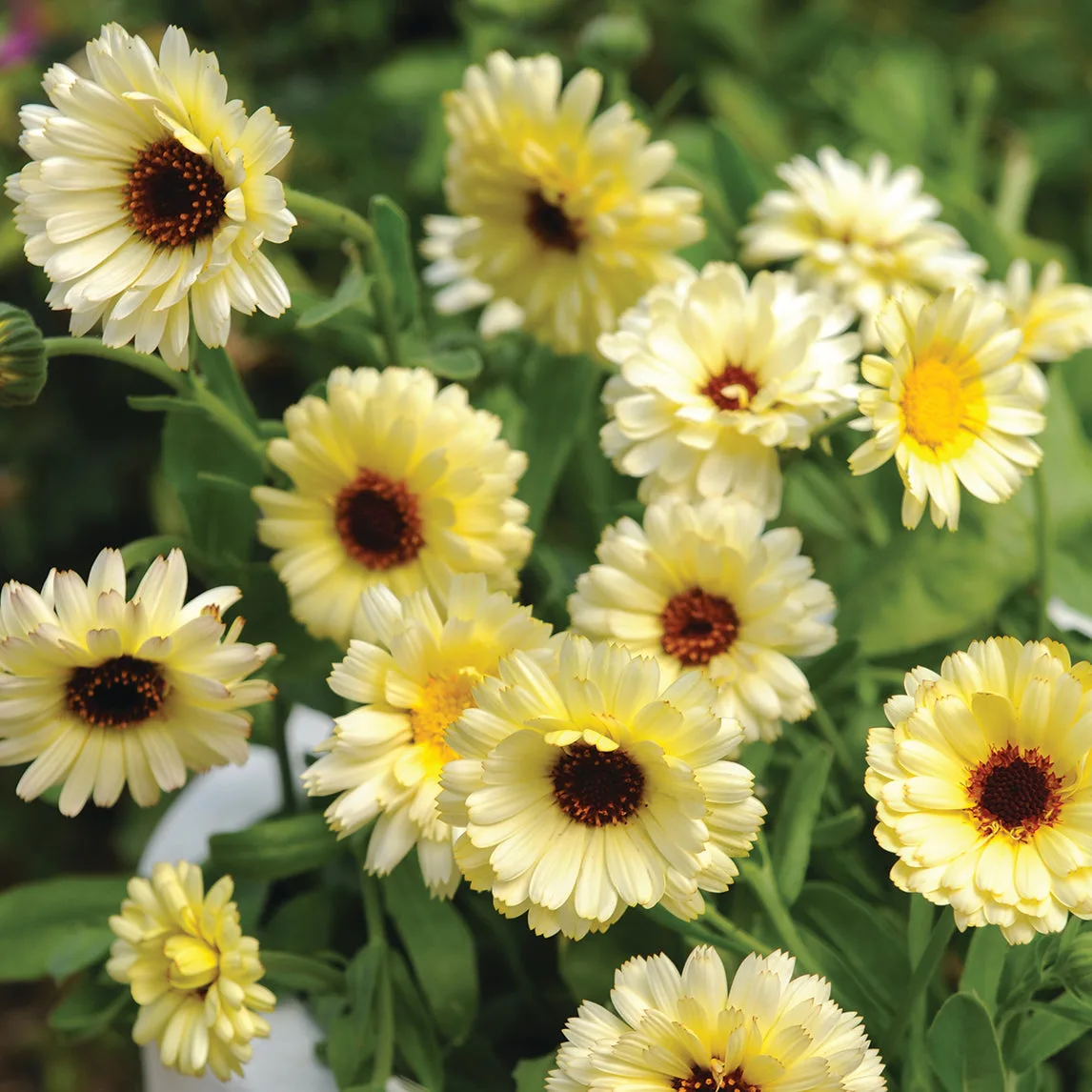
A hardy, mound-forming, bushy annual or biennial with aromatic and slightly sticky dark green spoon or lance-shaped leaves. Depending on their maturity, semi-double daisy-like flowers reach 7.5cm across which are creamy lemon on their upper surface and a rich butter yellow on their reverse with a dark brown/yellow central eye. Flowers appear from May to September, are edible and good for cutting.
Scientific classification
- Species
- marigold 'Snow Princess' (Calendula officinalis 'Snow Princess')
- Genus
- Calendula
- Family
- Asteraceae
- Order
- Asterales
- Class
- Magnoliopsida
- Phylum
- Magnoliophyta
- Information to be completed
- Toxicity
- Annual Biennial
- Plant type
- 0.1-0.5 metres
- Height
- 0.1-0.5 metres
- Spread
- Deciduous
- Foliage
- Bushy
- Habit
- Spring · Summer · Autumn
- Season of interest
- Full sun · Partial shade
- Sunlight
- Information to be completed
- Ideal temperature









marigold 'Snow Princess' pictures
Distribution of marigold 'Snow Princess'
Distribution map
- Native
- Introduced
- Cultivated
Source:WCVP v16 · Royal Botanic Gardens, Kew · CC BY 3.0 · Boundaries:WGSRPD / TDWG
marigold 'Snow Princess' care guide
- Keep soil consistently moist for tender leafy growth
- Watering
- Full sun · Partial shade
- Sunlight

Watering
Keep soil consistently moist for tender leafy growth
Fertilizing
 Fertilizing
Nitrogen-rich vegetable feed during active growth
Pruning
 Pruning
Deadhead to prolong flowering. Cut back after flowering or remove.
Propagation
 Propagation
Propagate by seed
Growing
 Growing
Thrives in moist, well-drained poor to moderately fertile soil. Easily grown from seed sown in situ or in seed trays in late spring or early autumn. Plant out 30cm apart. Flowers approximately ten weeks after sowing.
Common pests and diseases
Diseases
May be susceptible to powdery mildew and a virus
Pests
May be susceptible to aphids
Explore the plant health library →




