
crocus 'Orange Monarch'
Also known as: Information to be completed
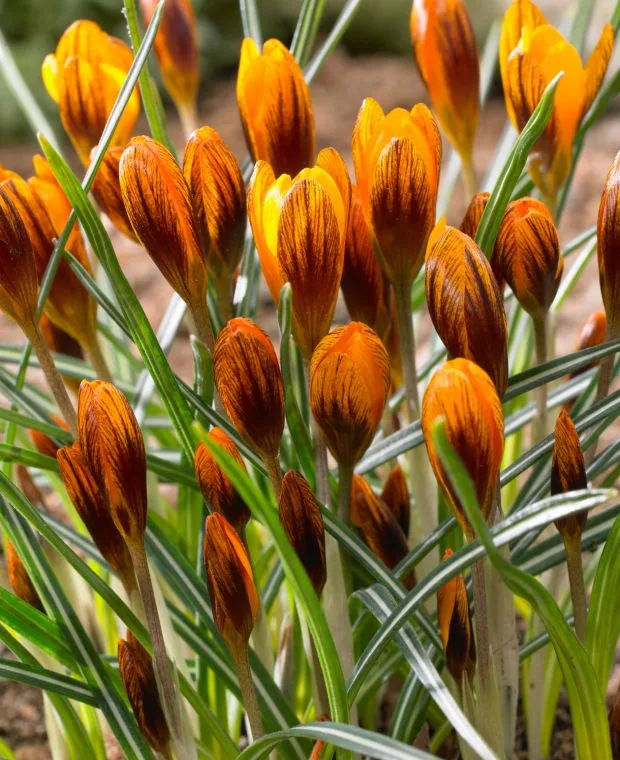
A small, perennial corm, growing to 8cm tall with long, narrow, dark green leaves marked with a fine, central, white stripe. In spring produces golden-orange, goblet-shaped flowers with very dark purple-black feathering on the outer three petals
Scientific classification
- Species
- crocus 'Orange Monarch' (Crocus olivieri subsp. balansae 'Orange Monarch')
- Genus
- Crocus
- Family
- Iridaceae
- Order
- Asparagales
- Class
- Liliopsida
- Phylum
- Tracheophyta
- Ornamental bulbs - not to be eaten. Wear gloves and other protective equipment when handling
- Toxicity
- Bulbs
- Plant type
- Up to 10 cm
- Height
- 0-0.1 metre
- Spread
- Deciduous
- Foliage
- Tufted
- Habit
- Spring
- Season of interest
- Full sun
- Sunlight
- Information to be completed
- Ideal temperature









crocus 'Orange Monarch' pictures
Distribution of crocus 'Orange Monarch'
Distribution map
- Native
- Introduced
- Cultivated
Source:WCVP v16 · Royal Botanic Gardens, Kew · CC BY 3.0 · Boundaries:WGSRPD / TDWG
Toxicity
Ornamental bulbs - not to be eaten. Wear gloves and other protective equipment when handling
crocus 'Orange Monarch' care guide
- Moderate regular watering, allowing brief slight drying between soakings
- Watering
- Full sun
- Sunlight

Watering
Moderate regular watering, allowing brief slight drying between soakings
Fertilizing
 Fertilizing
Balanced perennial feed every four weeks from spring through summer
Pruning
 Pruning
No pruning required
Propagation
 Propagation
Propagate by division of established clumps or by separating cormlets when dormant
Growing
 Growing
Grow in gritty, well-drained, poor to moderately fertile soil in full sun and protect from excessive winter wet
Common pests and diseases
Diseases
Generally disease-free, corms may rot in storage
Pests
May be susceptible to rodents and birds
Explore the plant health library →




