
Pyrus communis 'Obelisk'
Also known as: Information to be completed
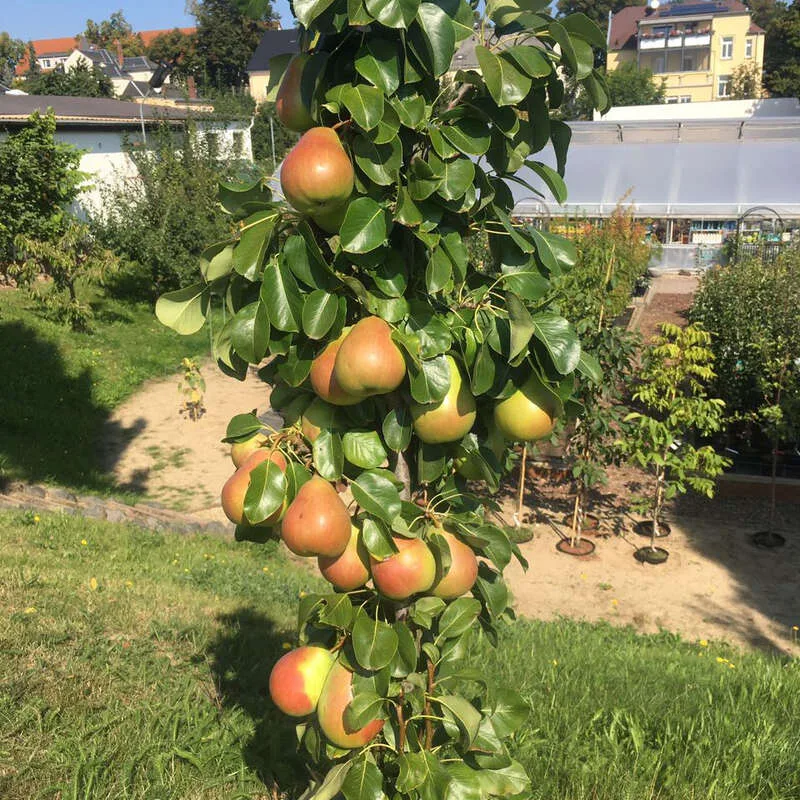
A dwarf deciduous tree of columnar form, reaching 2.5m. It has glossy green leaves which become yellow in autumn. It is self-fertile and its white blossom in spring develops into late-picking green fruit with a flush of red
Scientific classification
- Species
- Pyrus communis 'Obelisk' (Pyrus communis 'Obelisk')
- Genus
- Pyrus
- Family
- Rosaceae
- Order
- Rosales
- Class
- Magnoliopsida
- Phylum
- Magnoliophyta
- Information to be completed
- Toxicity
- Fruit Edible · Trees
- Plant type
- 1.5-2.5 metres
- Height
- 1-1.5 metres
- Spread
- Deciduous
- Foliage
- Columnar upright
- Habit
- Autumn · Spring · Summer
- Season of interest
- Full sun
- Sunlight
- Information to be completed
- Ideal temperature









Pyrus communis 'Obelisk' pictures
Distribution of Pyrus communis 'Obelisk'
Distribution map
- Native
- Introduced
- Cultivated
Source:WCVP v16 · Royal Botanic Gardens, Kew · CC BY 3.0 · Boundaries:WGSRPD / TDWG
Pyrus communis 'Obelisk' care guide
- Deep watering during dry spells, allowing slight surface drying between soakings
- Watering
- Full sun
- Sunlight

Watering
Deep watering during dry spells, allowing slight surface drying between soakings
Fertilizing
 Fertilizing
Balanced shrub or tree feed once each early spring
Pruning
 Pruning
Requires regular pruning. For more advice see pruning new pear trees, summer pear pruning and winter pear pruning
Propagation
 Propagation
Propagate by grafting or chip budding onto a clonal rootstock for fruit; quince rootstocks are usually used. The rootstock used largely determine the size
Growing
 Growing
Grow in full sun, in deep fertile soil which isn't too alkaline. For more advice see pear cultivation
Common pests and diseases
Diseases
May be susceptible to brown rots, European pear rust and pear scab
Pests
May be susceptible to pear blister mite and pear midge
Explore the plant health library →




