
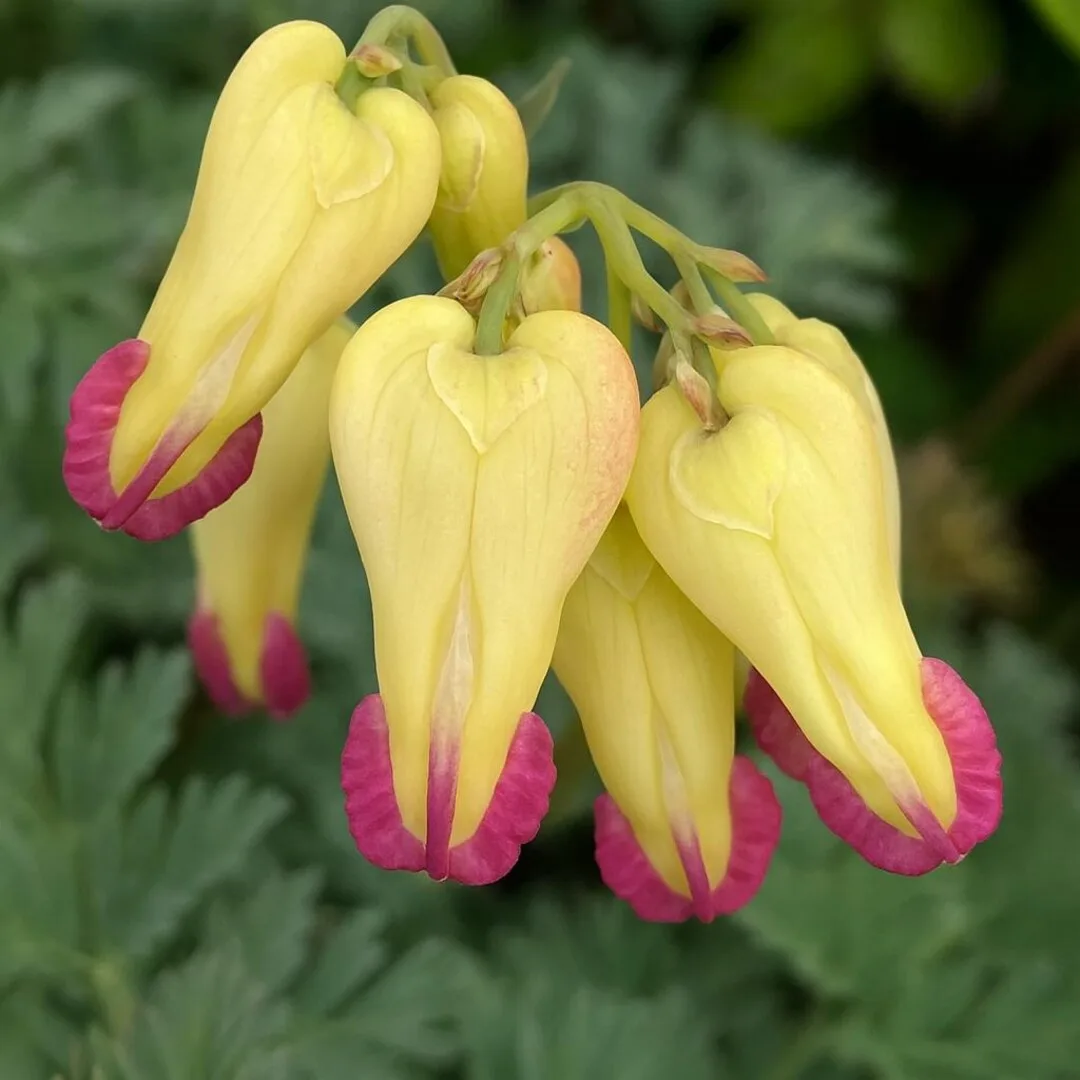
bleeding heart 'Love Hearts'
Also known as: Information to be completed
A clump-forming perennial about 45cm tall, with finely dissected, ferny, grey-green foliage, and sprays of white flowers flushed pale yellow-green with purple-red tips, produced from late spring to midsummer then intermittently to the autumn frosts
Scientific classification
- Species
- bleeding heart 'Love Hearts' (Dicentra 'Love Hearts')
- Genus
- Dicentra
- Family
- Papaveraceae
- Order
- Ranunculales
- Class
- Magnoliopsida
- Phylum
- Magnoliophyta
- Information to be completed
- Toxicity
- Herbaceous Perennial
- Plant type
- Information to be completed
- Height
- Information to be completed
- Spread
- Deciduous
- Foliage
- Clump forming
- Habit
- Spring · Summer · Autumn
- Season of interest
- Partial shade
- Sunlight
- Information to be completed
- Ideal temperature









bleeding heart 'Love Hearts' pictures
bleeding heart 'Love Hearts' care guide
- Moderate regular watering, avoid prolonged drought or waterlogging
- Watering
- Partial shade
- Sunlight

Watering
Moderate regular watering, avoid prolonged drought or waterlogging
Fertilizing
 Fertilizing
Balanced feed in spring and light repeat in growth season
Pruning
 Pruning
No pruning required
Propagation
 Propagation
Propagate by division in early spring or after the leaves have died down
Growing
 Growing
Plant in moist, fertile, humus-rich soil. Best in neutral or slightly alkaline soil, in part shade, in a sheltered position
Common pests and diseases
Diseases
Generally disease-free
Pests
May be suscceptible to slugs and snails damaging emerging foliage
Explore the plant health library →




