
Lilium 'Magny Cours'
Also known as: Information to be completed
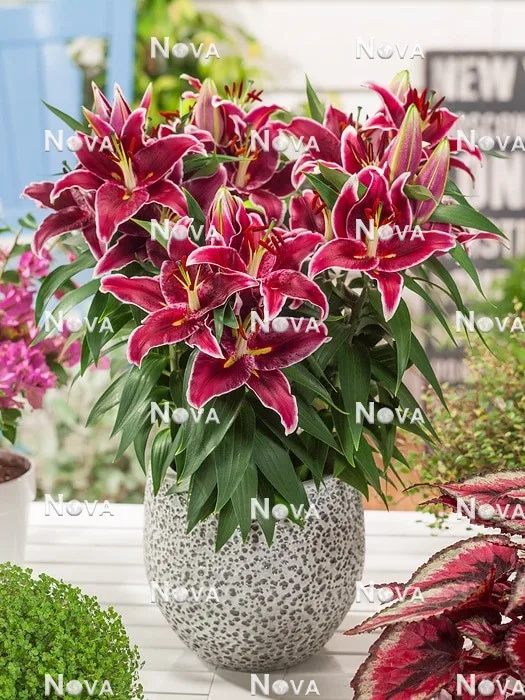
A deciduous, bulbous perennial with strap-like dark green leaves and lime green to dark pink-red buds that open to fragrant, deep red flowers with a white margin. Flowers are upward and outward-facing, appearing in July and August
Scientific classification
- Species
- Lilium 'Magny Cours' (Lilium 'Magny Cours')
- Genus
- Lilium
- Family
- Liliaceae
- Order
- Liliales
- Class
- Liliopsida
- Phylum
- Magnoliophyta
- Ornamental bulbs - not to be eaten. Wear gloves and other protective equipment when handling
- Toxicity
- Bulbs · Herbaceous Perennial
- Plant type
- 1-1.5 metres
- Height
- 0.1-0.5 metres
- Spread
- Deciduous
- Foliage
- Columnar upright
- Habit
- Spring · Summer · Autumn
- Season of interest
- Full sun · Partial shade
- Sunlight
- Information to be completed
- Ideal temperature









Lilium 'Magny Cours' pictures
Toxicity
Ornamental bulbs - not to be eaten. Wear gloves and other protective equipment when handling
Lilium 'Magny Cours' care guide
- Steady mild soil dampness, avoid complete substrate dehydration
- Watering
- Full sun · Partial shade
- Sunlight

Watering
Steady mild soil dampness, avoid complete substrate dehydration
Fertilizing
 Fertilizing
Diluted lily bulb feed every three spring-summer growing weeks
Pruning
 Pruning
No pruning required, but deadheading will improve their appearance
Propagation
 Propagation
Propagate by division: separate offsets after the leaves have died down
Growing
 Growing
Plant bulbs in autumn, 15cm deep, in moist but well-drained soil enriched with leaf mould or well-rotted organic matter, in a sheltered position, with the base of the plant in shade, for example from ground-cover plants, and the rest of the plant in full sun; for more advice, see growing lilies in containers
Common pests and diseases
Diseases
May be susceptible to lily disease, other fungal diseases, and virus diseases; for more advice, see lily diseases
Pests
May be susceptible to lily beetle, aphids, slugs, snails, Thrips, leatherjackets, and wireworms, and to damage by rabbits and voles; plants in containers may be affected by vine weevil
Explore the plant health library →




