
Rubus fruticosus 'Purple Opal'
Also known as: Information to be completed
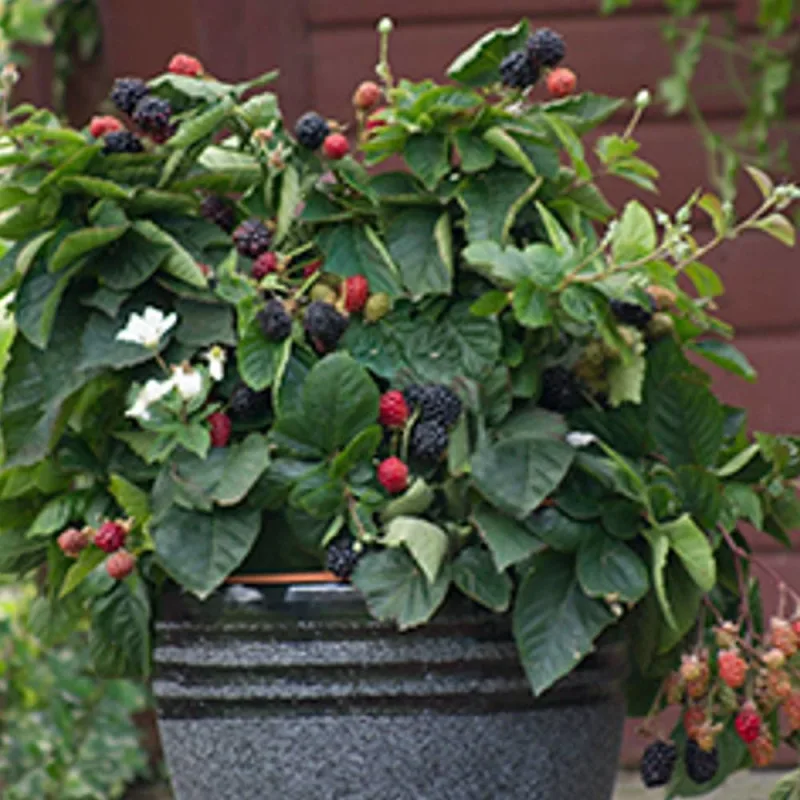
A mid-season blackberry with black fruit. It has green leaves on thornless stems and small white or pale pink flowers in the summer, producing its harvest in August-September.
Scientific classification
- Species
- Rubus fruticosus 'Purple Opal' (Rubus fruticosus 'Purple Opal')
- Genus
- Rubus
- Family
- Rosaceae
- Order
- Rosales
- Class
- Magnoliopsida
- Phylum
- Magnoliophyta
- Information to be completed
- Toxicity
- Fruit Edible
- Plant type
- 0.5-1 metres
- Height
- 0.5-1 metres
- Spread
- Evergreen · Semi evergreen
- Foliage
- Clump forming · Suckering
- Habit
- Autumn · Spring · Summer
- Season of interest
- Full sun · Partial shade
- Sunlight
- Information to be completed
- Ideal temperature









Rubus fruticosus 'Purple Opal' pictures
Distribution of Rubus fruticosus 'Purple Opal'
Distribution map
- Native
- Introduced
- Cultivated
Locally extinct or doubtful records are excluded from native and introduced layers.
Source:WCVP v16 · Royal Botanic Gardens, Kew · CC BY 3.0 · Boundaries:WGSRPD / TDWG
Rubus fruticosus 'Purple Opal' care guide
- Regular moderate moisture, reduce watering heavily in winter dormancy
- Watering
- Full sun · Partial shade
- Sunlight

Watering
Regular moderate moisture, reduce watering heavily in winter dormancy
Fertilizing
 Fertilizing
Berry bush balanced feed twice yearly spring and post fruiting season
Pruning
 Pruning
Once established, cut older fruited stems down to the ground once harvest is complete. Tie in new shoots to their framework.
Propagation
 Propagation
Propagate by division or tip layering
Growing
 Growing
Train to wires in a sheltered spot, in any moisture-retentive, fertile soil in sun or partial shade. Alternatively, as this is a compct variety, grow free-standing. Can be grown in a container. May have the potential to become a nuisance if not managed well. See blackberry cultivation for further advice
Common pests and diseases
Diseases
May be susceptible to grey moulds and honey fungus (rarely)
Pests
Generally pest-free
Explore the plant health library →




