
bell heather 'Rote Rosita'
Also known as: Information to be completed
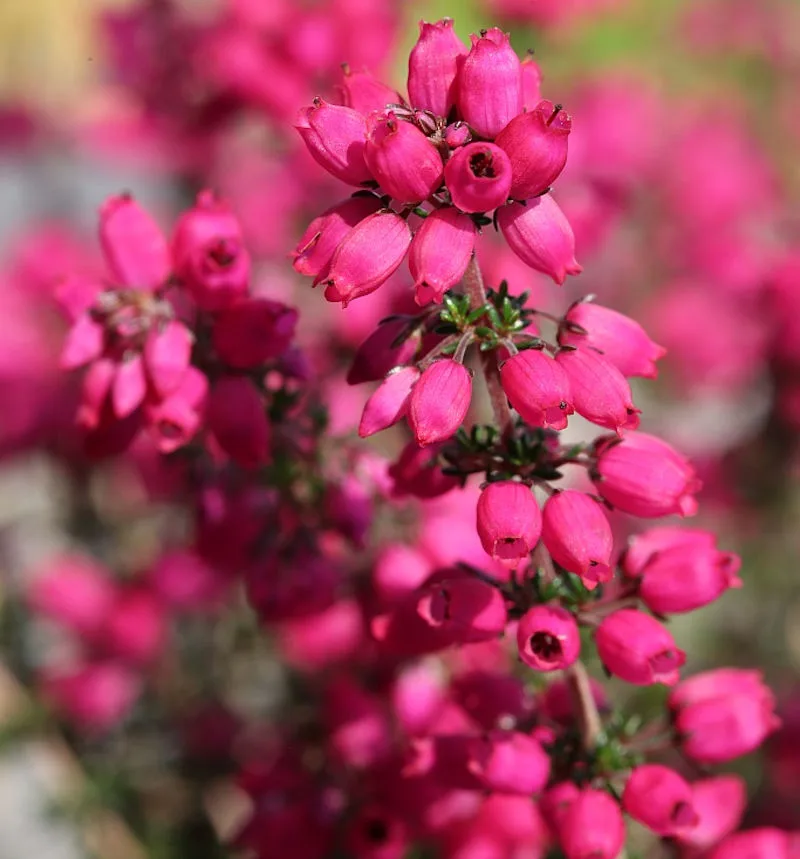
A compact, evergreen shrub up to 30cm tall, with tiny, narrow, dark green leaves. Short sprays of small bright crimson urn-shaped flowers are produced in summer
Scientific classification
- Species
- bell heather 'Rote Rosita' (Erica cinerea 'Rote Rosita')
- Genus
- Erica
- Family
- Ericaceae
- Order
- Ericales
- Class
- Magnoliopsida
- Phylum
- Magnoliophyta
- Information to be completed
- Toxicity
- Shrubs
- Plant type
- 0.1-0.5 metres
- Height
- 0.1-0.5 metres
- Spread
- Evergreen
- Foliage
- Bushy
- Habit
- Spring · Summer · Autumn · Winter
- Season of interest
- Full sun
- Sunlight
- Information to be completed
- Ideal temperature









bell heather 'Rote Rosita' pictures
Distribution of bell heather 'Rote Rosita'
Distribution map
- Native
- Introduced
- Cultivated
Source:WCVP v16 · Royal Botanic Gardens, Kew · CC BY 3.0 · Boundaries:WGSRPD / TDWG
bell heather 'Rote Rosita' care guide
- Slightly acidic moist soil, never let root zone dry completely
- Watering
- Full sun
- Sunlight

Watering
Slightly acidic moist soil, never let root zone dry completely
Fertilizing
 Fertilizing
Heath plant acidic feed monthly spring and summer growing time
Pruning
 Pruning
Shorten flowered shoots to about 1.5–2.5 cm from the previous year's growth. If flowering is on last year's growth, prune after flowering; if on current-year growth, prune the following early to mid-spring.
Propagation
 Propagation
Propagate by semi-hardwood cuttings in mid- or late summer
Growing
 Growing
Grow in well-drained acidic soil in full sun. See Hardy heathers for further advice
Common pests and diseases
Diseases
May be susceptible to fungal diseases, including honey fungus (rarely), and Phytophthora root rot, in wet conditions
Pests
Generally pest-free
Explore the plant health library →




