
tawhiwhi 'Golden Ball'
Also known as: Information to be completed
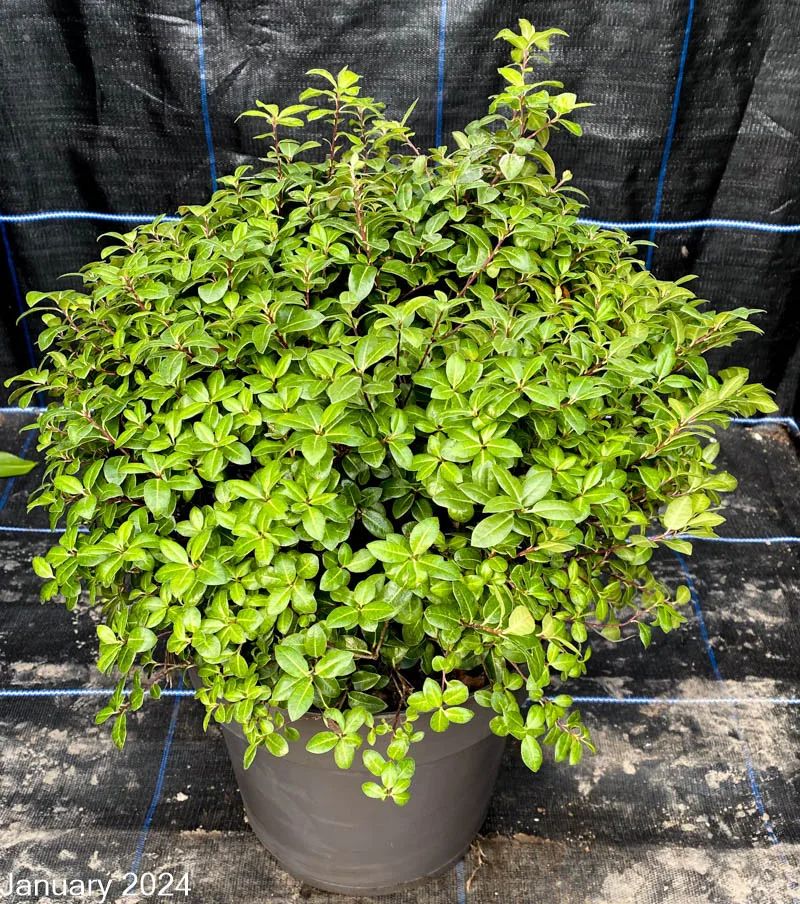
A variegated shrub with golden-yellow foliage when young, contrasting with older yellow-green leaves. It has small, purple flowers in May and June which smell of honey. With its natural globular shape, and suitability for topiary, 'Golden Ball' is possible alternative to Buxus balls.
Scientific classification
- Species
- tawhiwhi 'Golden Ball' (Pittosporum tenuifolium 'Golden Ball')
- Genus
- Pittosporum
- Family
- Pittosporaceae
- Order
- Apiales
- Class
- Magnoliopsida
- Phylum
- Magnoliophyta
- Information to be completed
- Toxicity
- Shrubs
- Plant type
- 1-1.5 metres
- Height
- 1-1.5 metres
- Spread
- Evergreen
- Foliage
- Bushy
- Habit
- Spring · Summer · Autumn · Winter
- Season of interest
- Full sun · Partial shade
- Sunlight
- Information to be completed
- Ideal temperature









tawhiwhi 'Golden Ball' pictures
Distribution of tawhiwhi 'Golden Ball'
Distribution map
- Native
- Introduced
- Cultivated
Source:WCVP v16 · Royal Botanic Gardens, Kew · CC BY 3.0 · Boundaries:WGSRPD / TDWG
tawhiwhi 'Golden Ball' care guide
- Moderate deep watering when top soil dries, well drain all surplus moisture
- Watering
- Full sun · Partial shade
- Sunlight

Watering
Moderate deep watering when top soil dries, well drain all surplus moisture
Fertilizing
 Fertilizing
General shrub slow-release fertilizer added once at start of spring growth
Pruning
 Pruning
Little pruning is needed. Remove diseased, damaged, crowded or crossing shoots and unwanted growth. Timing depends on the plant: generally late winter or early spring; plants prone to bleeding and deciduous magnolias need different timing, and deciduous azaleas and lilacs are pruned after flowering.
Propagation
 Propagation
Propagate by semi-hardwood cuttings in summer
Growing
 Growing
Easy to grow in fertile, moist but well-drained, soil. Plat in a sheltered spot as may need protection in colder climes especially from cold, drying winds.
Common pests and diseases
Diseases
May be susceptible to powdery mildews, leafspot and honey fungus (rarely)
Pests
May be susceptible to glasshouse red spider mite, aphids, cushion scale and pittosporum sucker
Explore the plant health library →




