
Turkestan clary 'Vatican Pink'
Also known as: Turkestan clary
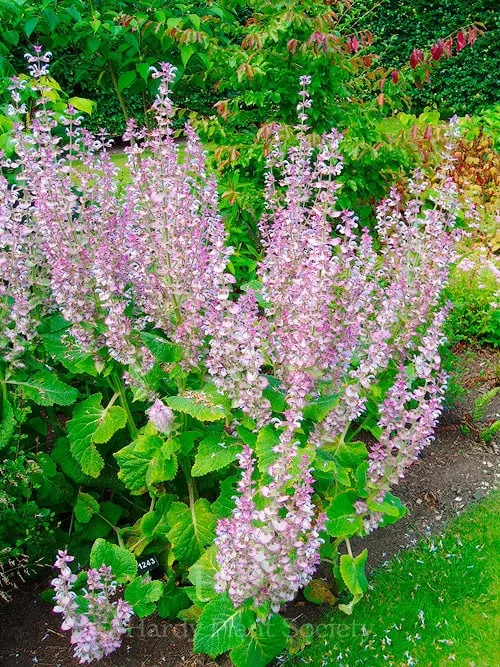
A biennial or short-lived perennial to 1m tall, with strongly-aromatic, wrinkled, oblong leaves to 20cm long, and tall, branched spires of pink and white flowers with conspicuous lilac bracts, opening in late spring and summer
Scientific classification
- Species
- Turkestan clary 'Vatican Pink' (Salvia sclarea var. turkestaniana 'Vatican Pink')
- Genus
- Salvia
- Family
- Lamiaceae
- Order
- Lamiales
- Class
- Magnoliopsida
- Phylum
- Tracheophyta
- Information to be completed
- Toxicity
- Annual Biennial
- Plant type
- 0.5-1 metres
- Height
- 0.1-0.5 metres
- Spread
- Deciduous
- Foliage
- Bushy
- Habit
- Spring · Summer · Autumn
- Season of interest
- Full sun
- Sunlight
- Information to be completed
- Ideal temperature









Turkestan clary 'Vatican Pink' pictures
Distribution of Turkestan clary 'Vatican Pink'
Distribution map
- Native
- Introduced
- Cultivated
Source:WCVP v16 · Royal Botanic Gardens, Kew · CC BY 3.0 · Boundaries:WGSRPD / TDWG
Turkestan clary 'Vatican Pink' care guide
- Moderate regular watering, allowing brief slight drying between soakings
- Watering
- Full sun
- Sunlight

Watering
Moderate regular watering, allowing brief slight drying between soakings
Fertilizing
 Fertilizing
Balanced perennial feed every four weeks from spring through summer
Pruning
 Pruning
Often dies after flowering. Do not remove flowers to allow self-seeding
Propagation
 Propagation
Propagate by seed, in pots in a cold frame in spring. Alternatively sow in situ in spring
Growing
 Growing
Grow in light, moderately fertile, humus-rich, moist but well-drained soil. Best in full sun but can tolerate light partial shade
Common pests and diseases
Diseases
May be susceptible to honey fungus (rarely), powdery mildews, verticillium wilt and foot and root rots
Pests
May be susceptible to sage leafhopper, slugs, snails and rosemary beetle
Explore the plant health library →




