
Euphorbia lactea 'Cristata'
Also known as: Information to be completed
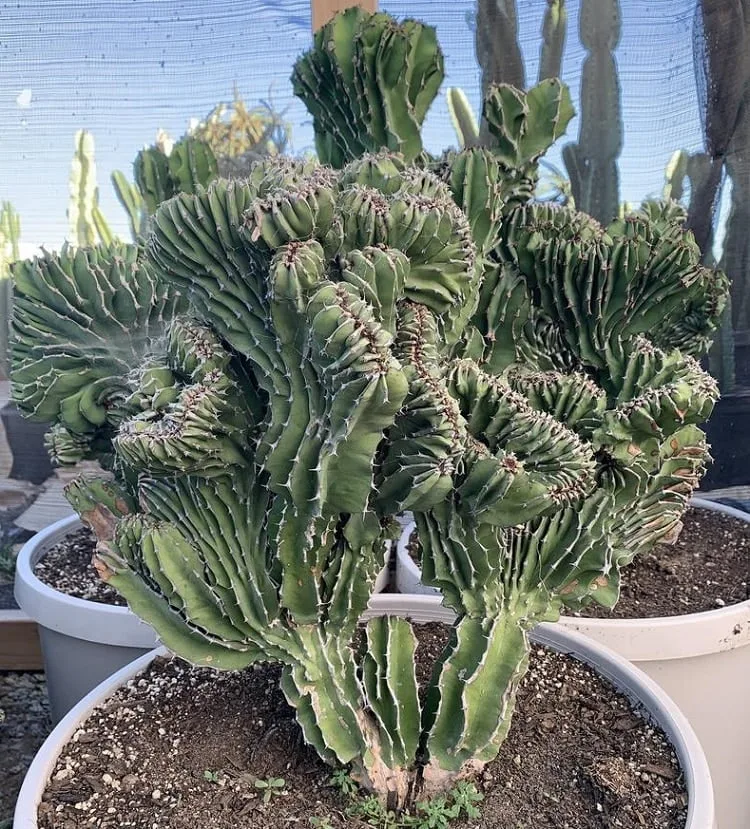
A compact, evergreen, frost-tender succulent shrub on which the stem's growing point has mutated into a line or crest, so that the plant eventually forms a dome to 90cm (3ft) high and 60cm (2ft) wide of ridged, undulating, reddish-green growth that resembles the appearance of brain coral. The small flowers are rarely produced, but can appear in spring and are a pinkish, green-yellow. It is usually grafted onto the stem of another euphorbia species. Its slow growth, temperature requirements and ornamental value make it a useful subject for a sunny window indoors.
Scientific classification
- Species
- Euphorbia lactea 'Cristata' (Euphorbia lactea 'Cristata')
- Genus
- Euphorbia
- Family
- Euphorbiaceae
- Order
- Malpighiales
- Class
- Magnoliopsida
- Phylum
- Magnoliophyta
- IRRITANT to skin/eye, harmful if eaten. Wear gloves and other protective equipment when handling]
- Toxicity
- Cactus Succulent
- Plant type
- 0.5-1 metres
- Height
- 0.5-1 metres
- Spread
- Evergreen
- Foliage
- Bushy
- Habit
- Spring · Summer · Autumn · Winter
- Season of interest
- Full sun · Partial shade
- Sunlight
- Information to be completed
- Ideal temperature









Euphorbia lactea 'Cristata' pictures
Distribution of Euphorbia lactea 'Cristata'
Distribution map
- Native
- Introduced
- Cultivated
Source:WCVP v16 · Royal Botanic Gardens, Kew · CC BY 3.0 · Boundaries:WGSRPD / TDWG
Toxicity
IRRITANT to skin/eye, harmful if eaten. Wear gloves and other protective equipment when handling]
Euphorbia lactea 'Cristata' care guide
- Moderate regular watering, allowing brief slight drying between soakings
- Watering
- Full sun · Partial shade
- Sunlight

Watering
Moderate regular watering, allowing brief slight drying between soakings
Fertilizing
 Fertilizing
Balanced perennial feed every four weeks from spring through summer
Pruning
 Pruning
No pruning required
Propagation
 Propagation
Propagate by grafting
Growing
 Growing
Grows best in well-drained soil, in full sun to partial shade. See Euphorbia for further advice
Common pests and diseases
Diseases
Generally disease-free
Pests
May be susceptible to mealybugs
Explore the plant health library →




