
lily [Roselily Aisha]
Also known as: Information to be completed
A bulbous herbaceous perennial with dark green glossy leaves and double white fragrant flowers which appear from mid to late summer. Double oriental lillies such as this have extra petals rather than anthers so are pollen-free
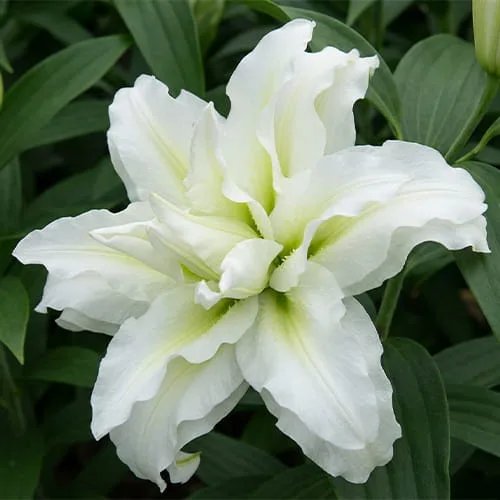
Scientific classification
- Species
- lily [Roselily Aisha] (Lilium Roselily Aisha ('Dl102085'))
- Genus
- Lilium
- Family
- Liliaceae
- Order
- Liliales
- Class
- Liliopsida
- Phylum
- Magnoliophyta
- Ornamental bulbs - not to be eaten. Wear gloves and other protective equipment when handling
- Toxicity
- Bulbs · Herbaceous Perennial
- Plant type
- 0.5-1 metres
- Height
- 0.1-0.5 metres
- Spread
- Deciduous
- Foliage
- Clump forming
- Habit
- Spring · Summer · Autumn
- Season of interest
- Full sun · Partial shade
- Sunlight
- Information to be completed
- Ideal temperature









lily [Roselily Aisha] pictures
Toxicity
Ornamental bulbs - not to be eaten. Wear gloves and other protective equipment when handling
lily [Roselily Aisha] care guide
- Consistently moist loose soil, avoid fully drying bulb root zones
- Watering
- Full sun · Partial shade
- Sunlight

Watering
Consistently moist loose soil, avoid fully drying bulb root zones
Fertilizing
 Fertilizing
Diluted lily bulb feed every two weeks pre-flower bud opening
Pruning
 Pruning
No pruning required, but deadheading will improve their appearance
Propagation
 Propagation
Propagate by division: detach offset bulblets when the leaves die down and plants become dormant
Growing
 Growing
Plant bulbs in autumn, 15cm deep, in moist but well-drained soil enriched with leaf mould or well-rotted organic matter, in a sheltered position, with the base of the plant in shade, for example from ground-cover plants, and the rest of the plant in full sun or light dappled shade; for more advice, see growing lilies in containers. As flower heads can become large, may need staking before blooming to prevent wind damage. See staking perennials for further advice
Common pests and diseases
Diseases
May be susceptible to grey moulds and a virus; see lily diseases
Pests
May be susceptible to lily beetle, aphids, slugs, snails, thrips, leatherjackets, and wireworms, and by rabbits and voles; plants in containers may be susceptible to vine weevil
Explore the plant health library →




