
anise-scented sage [Black and Bloom]
Also known as: Information to be completed
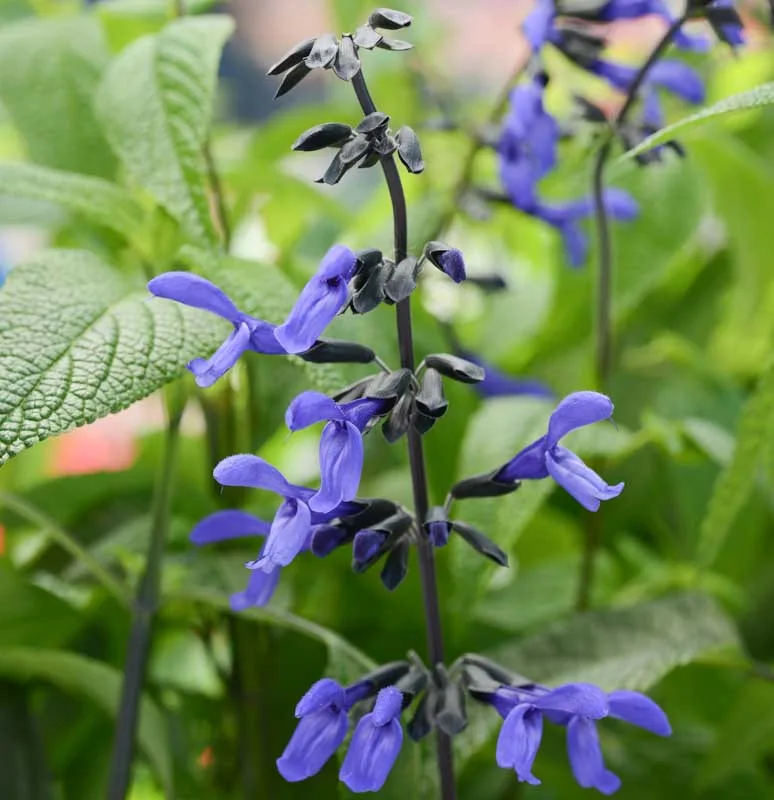
A tall perennial to 120cm tall, forming a wide clump of stems bearing dark green ovate leaves and loose spikes of vivid cobalt blue flowers, contrasting with black calyx, and opening in mid-summer and autumn
Scientific classification
- Species
- anise-scented sage [Black and Bloom] (Salvia guaranitica 'Black and Bloom')
- Genus
- Salvia
- Family
- Lamiaceae
- Order
- Lamiales
- Class
- Magnoliopsida
- Phylum
- Tracheophyta
- Information to be completed
- Toxicity
- Herbaceous Perennial
- Plant type
- 1-1.5 metres
- Height
- 1-1.5 metres
- Spread
- Deciduous
- Foliage
- Bushy
- Habit
- Spring · Summer · Autumn
- Season of interest
- Full sun
- Sunlight
- Information to be completed
- Ideal temperature









anise-scented sage [Black and Bloom] pictures
Distribution of anise-scented sage [Black and Bloom]
Distribution map
- Native
- Introduced
- Cultivated
Source:WCVP v16 · Royal Botanic Gardens, Kew · CC BY 3.0 · Boundaries:WGSRPD / TDWG
anise-scented sage [Black and Bloom] care guide
- Moderate regular watering, allowing brief slight drying between soakings
- Watering
- Full sun
- Sunlight

Watering
Moderate regular watering, allowing brief slight drying between soakings
Fertilizing
 Fertilizing
Balanced perennial feed every four weeks from spring through summer
Pruning
 Pruning
Remove faded flowers to encourage further flowering
Propagation
 Propagation
Propagate by division of established clumps. Take softwood and semi-ripe stem-tip cuttings from new non-flowering growth. Take basal stem cuttings from new shoots that are about 8cm (3in) tall
Growing
 Growing
Best grown in full sun, in well-drained soil with shelter from cold winds. Maintain low humidity for plants overwintered indoors in a greenhouse. Under glass grow in well-drained loamless or loam-based potting compost (JI No.2) in full light with shade from hot sun
Common pests and diseases
Diseases
May be susceptible to honey fungus (rarely), powdery mildews, verticillium wilt and foot and root rots
Pests
May be susceptible to slugs and snails, capsid bug, leafhoppers, aphids, glasshouse red spider mite and glasshouse whitefly
Explore the plant health library →




