
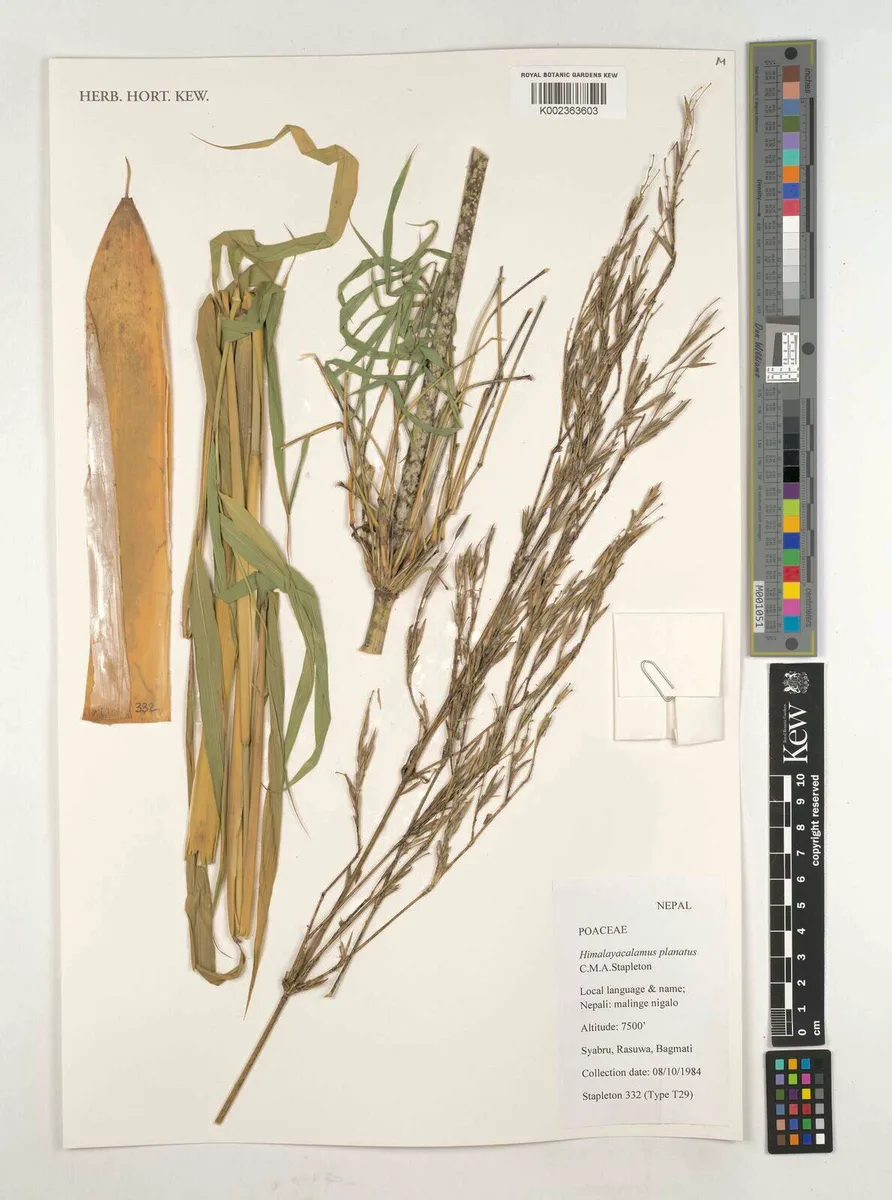
Himalayacalamus planatus
Also known as: Information to be completed
Large bamboo forming clumps of dense, dark green canes about 5m tall, tinged purple, maturing to red-brown, dark red in sun with pale hairy sheaths. Delicate, linear mid-green leaves to 13cm long turn orange-red in cold weather
Scientific classification
- Species
- Himalayacalamus planatus (Himalayacalamus planatus)
- Genus
- Himalayacalamus
- Family
- Poaceae
- Order
- Poales
- Class
- Liliopsida
- Phylum
- Magnoliophyta
- Information to be completed
- Toxicity
- Bamboos
- Plant type
- 4-8 metres
- Height
- 2.5-4 metres
- Spread
- Deciduous · Semi evergreen
- Foliage
- Clump forming
- Habit
- Autumn · Spring · Summer · Winter
- Season of interest
- Full sun · Partial shade
- Sunlight
- Information to be completed
- Ideal temperature









Himalayacalamus planatus pictures
Distribution of Himalayacalamus planatus
Distribution map
- Native
- Introduced
- Cultivated
Source:WCVP v16 · Royal Botanic Gardens, Kew · CC BY 3.0 · Boundaries:WGSRPD / TDWG
Himalayacalamus planatus care guide
- Deep regular watering in dry heat, mulch to stabilize soil moisture level
- Watering
- Full sun · Partial shade
- Sunlight

Watering
Deep regular watering in dry heat, mulch to stabilize soil moisture level
Fertilizing
 Fertilizing
Slow-release bamboo feed once annually applied at early spring time
Pruning
 Pruning
Remove weak, dead, damaged or spindly stems in spring and to show off stems to best effect. Cut out any flowering shoots promptly to discourage more from forming
Propagation
 Propagation
Propagate by division in early spring
Growing
 Growing
Grow in humus-rich, moist but well-drained soil in sun or partial shade, sheltered from cold, dry winds. See bamboo cultivation and bamboo control
Common pests and diseases
Diseases
Generally disease-free
Pests
Generally pest-free
Explore the plant health library →




