
bergamot 'Bubblegum Blast'
Also known as: Information to be completed
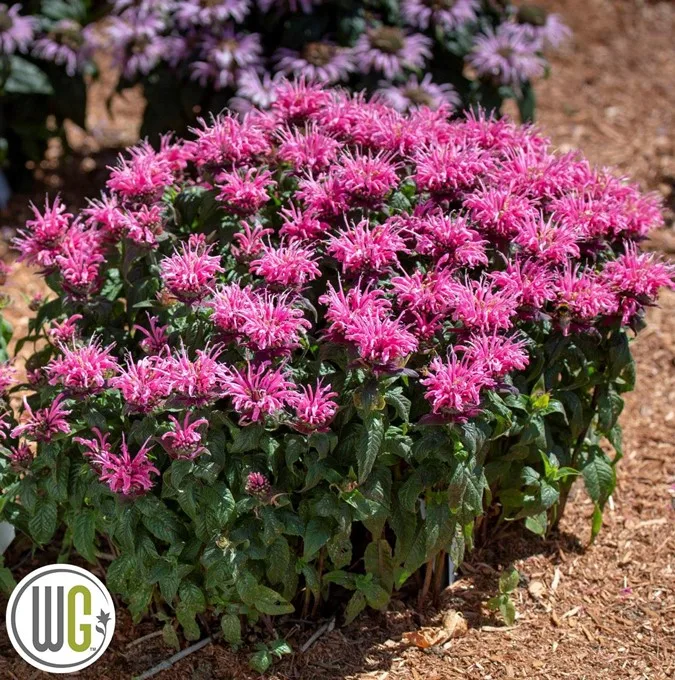
A vigorous, compact, clump-forming perennial to 30cm tall, with lance-shaped, aromatic, dark green foliage. In summer, each upright stem carries a whorl of two-lipped, tubular, bright pink flowers with decorative, bronzy bracts
Scientific classification
- Species
- bergamot 'Bubblegum Blast' (Monarda didyma 'Bubblegum Blast')
- Genus
- Monarda
- Family
- Lamiaceae
- Order
- Lamiales
- Class
- Magnoliopsida
- Phylum
- Magnoliophyta
- Information to be completed
- Toxicity
- Herbaceous Perennial
- Plant type
- 0.1-0.5 metres
- Height
- 0.1-0.5 metres
- Spread
- Deciduous
- Foliage
- Clump forming
- Habit
- Spring · Summer · Autumn
- Season of interest
- Full sun · Partial shade
- Sunlight
- Information to be completed
- Ideal temperature









bergamot 'Bubblegum Blast' pictures
Distribution of bergamot 'Bubblegum Blast'
Distribution map
- Native
- Introduced
- Cultivated
Source:WCVP v16 · Royal Botanic Gardens, Kew · CC BY 3.0 · Boundaries:WGSRPD / TDWG
bergamot 'Bubblegum Blast' care guide
- Water deeply at root zone, allow top layer to dry before rewatering
- Watering
- Full sun · Partial shade
- Sunlight

Watering
Water deeply at root zone, allow top layer to dry before rewatering
Fertilizing
 Fertilizing
Light balanced fertilizer once monthly during warm growing months
Pruning
 Pruning
Deadheading regularly should encourage more flowers. Cut stems down to the ground in autumn, or leave seed heads for winter structure
Propagation
 Propagation
Propagate by division in early spring, before new growth begins, or by basal softwood cuttings
Growing
 Growing
Grow in fertile, humus-rich, moist but well-drained soil in full sun or partial shade. Protect from excessive winter wet and do not allow to dry out in summer. Lift and divide every three years
Common pests and diseases
Diseases
May be susceptible to powdery mildews in hot, dry weather, though this variety is said to show good resistance
Pests
May be susceptible to slugs, especially in spring
Explore the plant health library →




